When Should You Upgrade Your First Car in the UK
Most advice treats the upgrade question as a repair-bills calculation. For new drivers, it's really about your no-claims history, insurance group, and total running cost, and getting that wrong is expensive. Here's how to think it through.
Why the upgrade question is different for new drivers
The standard rule of thumb, upgrade when annual repair bills approach the car’s value, is written for experienced drivers. Someone with five years of no-claims discount and a track record that keeps premiums manageable can treat the upgrade decision as a simple mechanical calculation. For a new driver, that logic is missing its biggest variable.
In years one and two, the premium is often the largest single running cost, larger than fuel, servicing, and tyres combined. One user summed up the problem exactly: “Insurance costs twice the value of the car, before you fall in love with it.” That reality means the upgrade question is not really about the car you are leaving. It is about whether the total annual cost of the replacement, purchase price, insurance, tax, and servicing, genuinely beats the total cost of staying put. Sticker price and MOT advisory list are not enough.
The no-claims discount is the asset you are actually protecting
No-claims discount (NCD) is not just a future saving, it is money you have already earned. Each clean year builds a discount that compounds: typically around 30% after year one, rising toward 60 to 65% by year five, though exact figures vary by insurer. One driver in our community saw their annual premium drop from £2,500 in year one to £700 at renewal after one clean year on a black box, a saving of £1,800 in a single step.
What new drivers often discover too late is that changing car mid-policy can be expensive in ways that have nothing to do with the replacement vehicle. Insurers charge mid-term adjustment fees for a vehicle change, and one user reported being hit with a surprise £550 to make the switch. Worse, if the policy is cancelled rather than transferred, NCD can be lost in transit. The timing of a switch relative to your renewal date genuinely matters: one parent in our research found a £1,200 difference depending on when cover started, and a further £700 saving by not yet owning the car at the point of applying. Those are real, recoverable sums that most buyers never think to look for.
When staying in your first car is the smarter move
There is a pattern that shows up consistently in new driver behaviour, and it is usually financially correct: “I want something I can keep for one to two years to get my insurance down before I get a nicer car.” That instinct is right.
Within year one, upgrading almost never makes financial sense unless the current car has become genuinely unsafe or structurally unsuitable. You have not yet earned enough NCD for it to meaningfully reduce what you pay on any replacement. After an at-fault claim, the calculation gets harder still: your NCD is already damaged, and moving to a higher insurance group car compounds the cost rather than offsetting it.
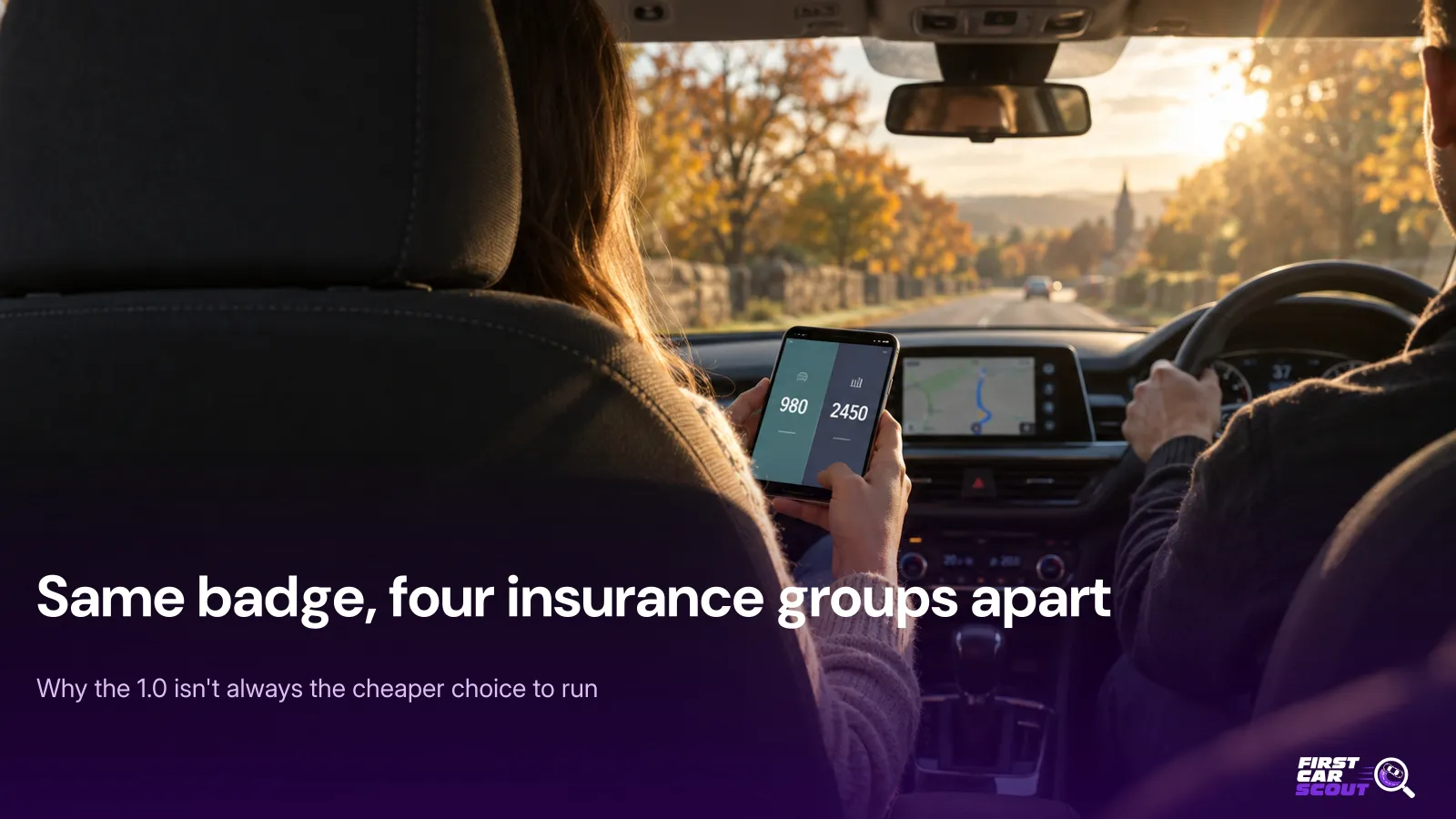
The other scenario where staying put wins: when the aspirational replacement sits in a significantly higher insurance group than the current car. A car that looks affordable to buy can carry a premium several hundred pounds a year higher. That gap, across a two-year ownership period, can easily exceed the purchase price difference between the two cars.
When upgrading genuinely makes sense, and what to check first
Two or more years of clean NCD is the clearest genuine trigger. By that point the discount is meaningful, your record is portable, and the insurance hit on a replacement is far more predictable. Other genuine triggers: a repair bill that, honestly costed, exceeds what a replacement would cost to insure and run for the same period; or a real life change, a new job requiring motorway driving, a growing family, that makes the current car structurally unsuitable.
Before any emotional attachment forms, run the exact registration and spec of the target car through a comparison site to get a real insurance estimate. Not the make and model in general, the specific car, because trim, engine, and year move insurance groups significantly. Then build the full annual running-cost picture: insurance, road tax, average fuel cost at your mileage, and a realistic servicing allowance. Compare that total against what you are currently spending, not just the purchase prices of the two cars.
Also check whether your current policy has a mid-term adjustment fee that would apply if you switch before renewal. If renewal is close, waiting a few weeks can be worth hundreds of pounds.
How to switch cars without losing what you have built
Notify your insurer before the switch, not after. Tell them the target car’s registration and get a revised premium in writing before you commit to buying. If the fee or premium increase is significant, it is worth asking whether waiting until renewal changes the numbers.
When the policy renews, your NCD transfers to the new policy, either with the same insurer or a new one. Always ask for written proof of NCD from your current insurer before switching providers. Do not assume it carries over automatically, some insurers are slow to issue proof and you may need it within days.
If you are on a black box policy, check the specific terms: some telematics insurers require a new device to be fitted on the replacement car, and the process takes time. Confirm cover is active on the new vehicle before you drive it.
FAQ
Does my no-claims discount transfer if I change cars mid-policy? Your NCD belongs to you, not the car. It transfers, but check whether your insurer charges a mid-term adjustment fee, and ask for written confirmation of your NCD balance before making any change.
Will my premium go up or down if I upgrade to a newer but bigger car? It depends entirely on the insurance group of the specific replacement car, not its age or price. A newer car in a higher group will cost more to insure. Always check the group and run an estimate on the actual registration before deciding.
How long should I keep my first car before upgrading? As a general guide, two clean years of NCD gives you a meaningful discount to carry forward. One year is enough to notice a difference at renewal, but two years is where the math starts to favour a switch.
What happens to my black box policy if I change cars? Most telematics insurers will transfer the policy to the new car, but a new device may need to be installed and there may be a fee or a short gap in monitoring. Confirm the process with your insurer before you exchange keys.