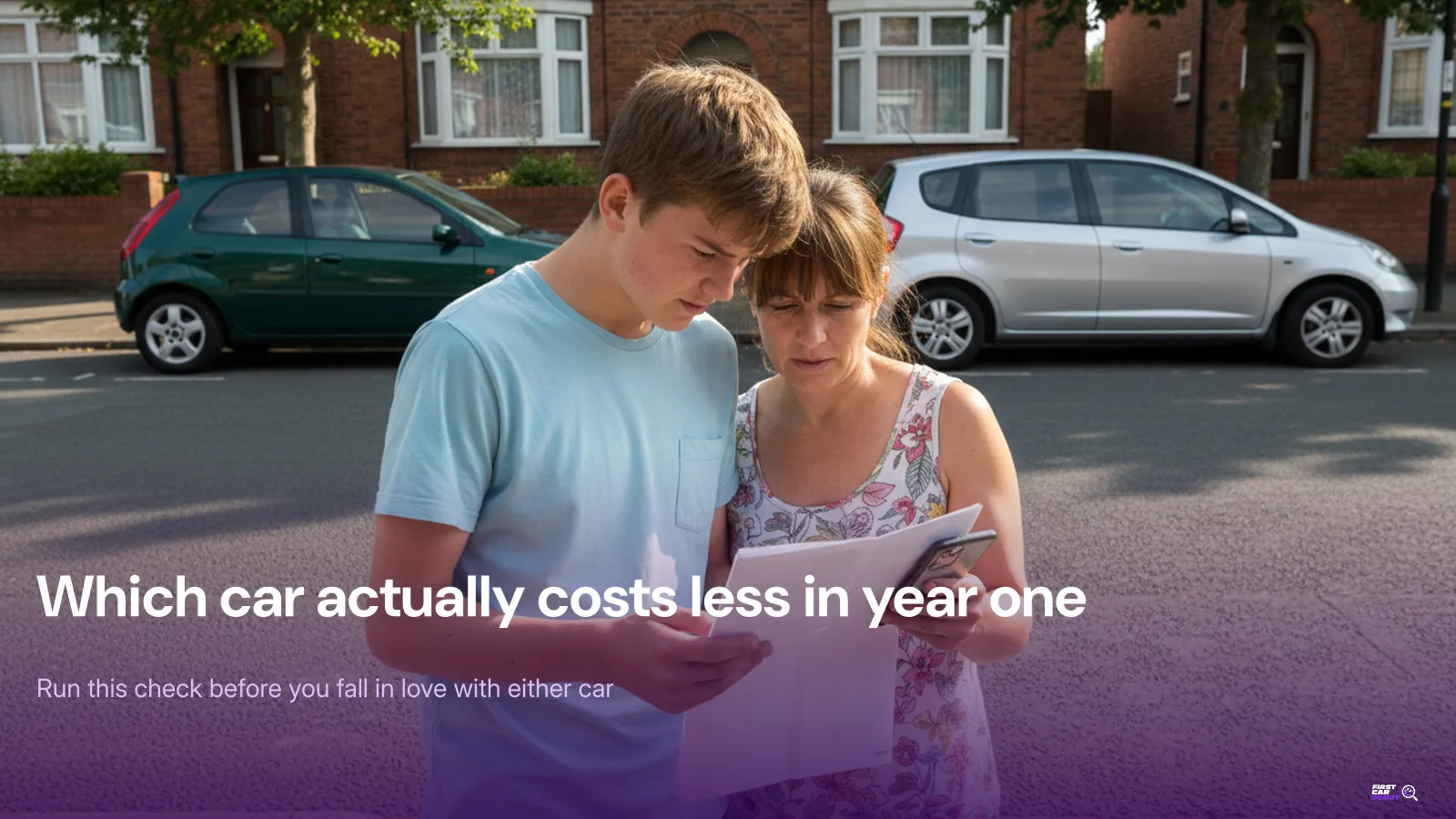
Why a low insurance group car can still cost more to run each month
FirstCarScout's own data shows that at September 2026 fuel prices, a car in insurance group 4 with modest mpg can cost more per month than a group 2 car with better efficiency. Here is how to check this yourself before you decide.
The short answer: insurance group is only part of the monthly bill
If someone has told you to just find a low insurance group car and you will be fine, they are giving you half the picture. Running a first car has four main costs: premiums, fuel, road tax, and servicing. Ignore any one of them and the car that looks cheapest on paper can quietly become the dearest one to own each month.
Fuel is where this bites hardest right now. At current UK pump prices, a car with a modest mpg figure can cost £20 or more extra per month in fuel compared with a more efficient alternative, even if its insurance group is lower. That gap can easily cancel out, or reverse, the saving you thought you were making on premiums.
FirstCarScout ranks first cars on the whole monthly bill at 8,000 miles a year, not on insurance group alone. The September 2026 edition shows exactly why that matters.
What our numbers actually show: a three-car comparison
All insurance figures below are estimates for an 18-year-old driver. Individual premiums will vary depending on postcode, driving history, policy type, and the exact car. Fuel costs use the DESNZ weekly road fuel price series for the week of 21 September 2026: petrol at about 172p a litre, diesel at about 196p a litre.
| Car | Insurance group | MPG | Est. premiums/month | Fuel/month | Total/month |
|---|---|---|---|---|---|
| Skoda Citigo 1.0 petrol | 2 | 65.3 | ~£155 | ~£80 | ~£259 |
| Volkswagen Polo 1.2 petrol | 4 | 50.5 | ~£145 | ~£103 | ~£281 |
| Volkswagen Golf 1.6 diesel | Higher | 72.6 | n/a | ~£82 | n/a |
The Polo’s premium estimate is about £10 a month lower than the Citigo’s. But its fuel cost is about £23 a month higher. On total monthly running cost, the Citigo comes out roughly £22 a month cheaper, even though it costs about £10 a month more to insure.
The Golf column illustrates a separate trap. Its official mpg is 72.6, higher than either petrol car, yet its fuel cost is about £82 a month, close to the Citigo’s, because diesel costs about 196p a litre against petrol’s 172p. Higher mpg does not automatically mean cheaper to fuel when the fuel itself costs more per litre.
The Polo led FirstCarScout’s Best First Cars list for four months. In the September 2026 edition it has dropped to fifth, partly because the fuel cost difference has overtaken its premium advantage at current prices. In mid-September 2026 we also lowered the price ceiling for the list to £8,000, which affected the rankings further.
Why fuel prices changed the ranking
The Polo’s roughly £10-a-month premium saving is small next to its fuel bill. At around 172p a litre, the fuel gap between the Polo and the Citigo has grown to about £23 a month. That more than doubles the premium saving and gives the Citigo a roughly £22-a-month total advantage.
This is not a permanent verdict on either car. If petrol prices fall, the relationship shifts again. It is why FirstCarScout re-runs its ranking monthly rather than publishing a fixed badge list. A static “best first cars” list that ignores current fuel prices can be meaningfully wrong by the time you read it.
The diesel example reinforces the point from the other direction. The Golf’s superior mpg looks compelling until you account for diesel’s higher pump price, at which point the real-world monthly fuel cost ends up similar to the petrol Citigo’s.
How to check this yourself before you fall in love with a car
The formula for monthly fuel cost is straightforward:
(Annual miles ÷ MPG) × 4.546 × price per litre ÷ 12
Worked through with the Citigo at 8,000 miles a year, 65.3 mpg, and 172p a litre:
(8,000 ÷ 65.3) × 4.546 × 1.72 ÷ 12 = roughly £80 a month.
Run the same sum for any car you are considering and you have a direct comparison in minutes.
Two practical warnings before you do:
First, the same model badge can cover a wide range of mpg figures depending on the exact engine and trim. A Polo 1.0 and a Polo 1.2 are not the same car for this calculation. Always use the official combined mpg figure for the specific version you are looking at, not a general model average.
Second, do not use askMID to check a car’s insurance group. askMID is the Motor Insurers’ Bureau’s public tool and it checks whether a specific vehicle is currently insured on the Motor Insurance Database. It does not show insurance groups. For insurance group information, use a vehicle-spec site or run a real estimate on a comparison site using the actual registration.
Once you have the mpg figure and a premium estimate for the exact car and your own driver details, add them together. That combined number is what you are actually committing to each month.
What to do with this when you are ready to compare cars
The FirstCarScout Best First Cars guide lists cars already ranked on combined monthly cost at 8,000 miles a year, updated monthly to reflect current fuel prices. Use it as a starting point rather than a badge list.
When you find a specific listing, use the car finder to check the exact version. Premiums and mpg both vary by engine and trim, so the specific registration matters more than the model name.
The insurance figures in the comparison above are estimates for an 18-year-old driver. Your own premiums will depend on your postcode, driving history, the policy type you choose, and the exact car. Always get a real estimate for the actual car and driver before committing to anything.
Does a higher mpg car always cost less to fuel? Not if the fuel type costs more per litre. A diesel car returning 72 mpg can cost a similar amount to fuel each month as a petrol returning 65 mpg, because diesel currently costs around 24p a litre more than petrol at UK pumps (DESNZ, 21 September 2026).
Are the premium figures in the comparison real quotes? No. They are estimates based on an 18-year-old driver profile. Your own figure will vary. Treat them as a comparison baseline, not a prediction of what you will pay.