1.0 vs 1.2 Engine: Why the Insurance Difference Has Nothing to Do With Engine Size
Parents often assume a 1.0-litre engine is automatically cheaper to insure than a 1.2. It isn't always, and the reason why is something most advice never explains. Here's how insurance groups actually work, and what to check before you buy.

Why engine size alone doesn’t set your insurance group
Insurance groups in the UK run from 1 to 50. They’re set by Thatcham Research on behalf of the ABI Group Rating Panel, and they’re built from a combination of factors: the car’s new value, repair costs, parts availability, performance figures, and security rating. Engine displacement feeds in, but only indirectly, via power output.
That distinction matters. Two cars can share a similar engine size and land in very different groups depending on everything else that surrounds the engine. A parent comparing “1.0 vs 1.2” is working one level too high. The actual group is always attached to the specific trim, spec, and registration, not the headline number on the advert.
The correct workflow for checking any car is: find the exact insurance group for that registration or trim via a vehicle-spec site or comparison site, then run a real estimate using the actual reg. The Motor Insurers’ Bureau’s askMID tool is sometimes suggested at this stage, but it serves a different purpose entirely: it checks whether a specific vehicle is currently insured on the Motor Insurance Database. It tells you nothing about insurance groups and shouldn’t be used for that.
The turbo effect: when a 1.0 outprices a 1.2
The scenario the title promises to explain: modern turbocharged 1.0-litre engines are now standard across a wide range of popular cars. They’re efficient and responsive, but they also produce significantly more power than older or naturally aspirated units of a similar or slightly larger size.
A turbocharged 1.0 producing 100bhp or more can sit in a meaningfully higher insurance group than a naturally aspirated 1.2 making 60-odd bhp, because power output, repair complexity, and claims data all push the group upward. The smaller number on the spec sheet doesn’t automatically win. This is the flip most advice never mentions, and it’s where a family can confidently buy what they think is the safer choice and still be surprised at renewal.
If you’re comparing a modern turbocharged 1.0 EcoBoost, PureTech, or BoosterJet unit against an older naturally aspirated 1.2, the 1.0 may well sit in the higher group of the two. The only way to know is to check the actual group for the actual spec.
Trim and badge do as much damage as the engine
The same engine in two different trims of the same model can span several insurance groups. A base-trim 1.0-litre in a Fiesta, Corsa, or Polo is a different insurance proposition from the same engine fitted to an ST-Line, FR, or Sport variant, because the group rating includes the trim-level repair cost index, not just the engine.
Sport and performance trims typically carry more expensive body panels, sportier alloys, and higher new-list prices, all of which raise the group. Buyers who search for “a 1.0 Corsa” on a marketplace and assume they’re comparing equivalent cars are often looking at a wide spread of groups without realising it.
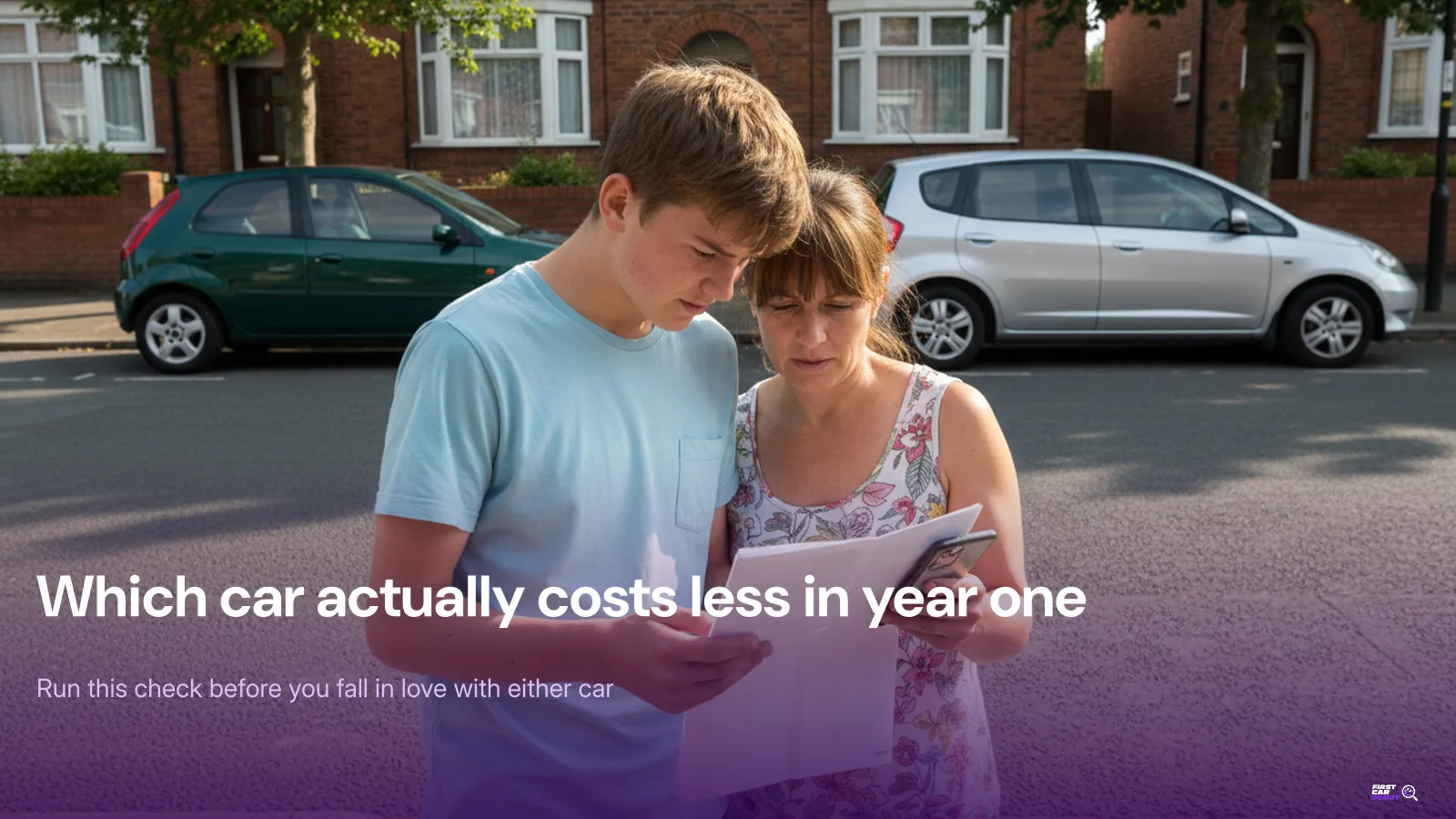
One question we see repeatedly from new drivers is why two seemingly similar cars produce estimates hundreds of pounds apart. This is usually why: same badge, same approximate engine, different trim, different group, different annual cost.
Check the exact registration before you fall in love with it
The practical workflow:
- Get the registration from the advert, not just the model and engine description.
- Look up the insurance group for that specific trim via a specs or comparison site.
- Run a provisional estimate as a newly passed driver before you view the car.
- Treat the first-year premium as part of the purchase price, not a number discovered afterwards.
The evidence from our own user research is consistent: the moment emotional attachment forms, after a test drive, after a parent says “it seems solid”, the insurance estimate stops feeling like a filter and starts feeling like a problem to solve. Check it first, while the car is still just a listing.
One Q&A we’ve seen from a grandparent highlights this clearly: a granddaughter had already bought a 1-litre Hyundai before discovering that estimates ranged from £275 to £615 per month. The car itself wasn’t the issue, the timing was. Checking before purchase, not after, is the only reliable way to avoid that situation.
What a genuinely low-group first car actually looks like
The cars where the engine-size-to-group relationship is most predictable and favourable share a few characteristics: naturally aspirated (not turbocharged) petrol engines, base or mid trims with modest repair indices, and common parts that keep labour and component costs low.
From verified data in our records:
- Hyundai i10 (2015-2017, petrol, manual): ABI insurance group 1, around 60mpg, VED recorded at around £65/yr (confirm current rate for your specific car).
- Volkswagen Up! (2013-2020, petrol, manual): ABI insurance group 1, around 62mpg.
- Kia Picanto (2011-2024, petrol, manual): ABI insurance group 3, around 61mpg.
- Toyota Aygo (2008-2014, petrol, manual): ABI insurance group 3, around 65mpg.
These figures are per-spec records, not guarantees, VED rates change by tax year and the group applies to the exact trim listed, not every version of that nameplate. But the pattern is consistent: a naturally aspirated engine in a base trim of a common, widely serviced model tends to land in a low group and stay there.
The asking price and the first-year premium together form the real year-one cost. A £4,000 car with a £1,800 annual premium costs more to run in year one than a £5,000 car at £900. Check both numbers before you compare.
FAQ
Does a turbo engine always mean a higher group? Not automatically, but it’s a meaningful signal. A turbocharged engine usually means higher power output and more complex repair costs, both of which push the group up. It’s not a rule, but it’s worth checking specifically.
How do I look up the insurance group for a specific car? Use the registration to find the exact trim on a vehicle-specs site or by running it through a comparison site. Don’t use askMID for this, it checks insurance status, not groups.
Why am I getting different estimates for two cars with the same engine size? Almost certainly trim level. Check the exact trim of each car and compare groups, not just engine sizes.
Is a newer 1.2 with better safety ratings cheaper to insure than an older 1.0? Not necessarily. A better Euro NCAP rating can support a lower group, but new-car value and repair costs often counteract it. Check the group for the specific registration rather than inferring from the safety rating alone.