Cheap Banger or Modern Safety Tech: Which First Car Actually Costs Less in Year One
The banger-versus-modern debate is really a maths problem, not a safety debate. Here is how to run the break-even calculation on any specific car before you fall in love with it.
Why the question is framed wrong
Most guides treat this as a safety debate and hand you a list of approved modern cars versus risky old bangers. That framing misses the actual decision.
For most realistic first-car budgets, safety and cost tend to pull in the same direction, not opposite ones. The attributes that push a car into a low insurance group (small engine, simple spec, common parts) also make it cheaper to repair and cheaper to run. A 2017 Hyundai i10 and a 2005 Corsa may both cost around £1,500 to buy, but they are completely different propositions once you add up everything a 12-month ownership spell actually costs.
The right lens is not sticker price alone. It is total first-year cost: purchase price, plus running costs (fuel, road tax), plus likely repair exposure, plus the cost of cover. Treat those as one number, not four separate decisions made in the wrong order.
What a £1,500 banger actually costs you in year one
A £1,500 car is only cheap if everything else stays cheap alongside it. It often doesn’t.
Older cars, especially those pre-dating 2012, can sit in higher insurance groups, attract higher premiums for other reasons (rarer parts, higher theft risk, less safety tech), or in some cases become genuinely difficult to get cover for at all. One of our users put it plainly: “Insurance cost climbs to the value of the car itself.” That is not a freak outcome. It is what happens when a low sticker price meets a high-group or hard-to-insure vehicle.
There is also the MOT risk. Our research finds that buyers frequently encounter cars with recurring advisories they cannot interpret: “Most cars I’m finding all have bad flaws checking their MOT histories.” A suspension advisory that has appeared on three consecutive MOTs is not the same as a one-off note. On a £1,500 car, a £600 repair bill does not just sting, it may exceed the vehicle’s resale value entirely.
A rough year-one model for a lower-end older car: £1,500 purchase, £300 to £600 in MOT-related repairs (plausible on a car this age with patchy history), plus fuel and tax. Before you even add cover, you are already at £2,000 or more. Cover on a car that sits in a higher group or has a larger engine can add substantially further.
What ‘modern safety tech’ actually adds, and what it costs
Not all modern features move the needle equally. Electronic stability control (ESC, compulsory on new cars from 2014), autonomous emergency braking (AEB), and multiple airbags have clear, evidence-backed effects on collision outcomes. Parking sensors and a reversing camera are useful for new drivers building spatial confidence, but they do not change the insurance group or the crash-survival odds in a meaningful way.
The threshold that matters practically is broadly 2015 onwards. Cars from around this point tend to combine: ESC and AEB as standard fitments, lower insurance groups (common 1.0 to 1.2 petrol engines were maturing into better-understood risk profiles by then), more reliable modern fuel injection (better real-world mpg than older equivalents), and road tax bands that are often lower on post-2017 vehicles registered under the newer VED system.
A 2016 to 2018 Hyundai i10, Kia Picanto, or Toyota Aygo in a base or mid trim can often be found for £3,000 to £5,000. That is more than a £1,500 banger. But the total first-year cost can still come out lower, because the cover, fuel, and repair exposure all tend to be more predictable.
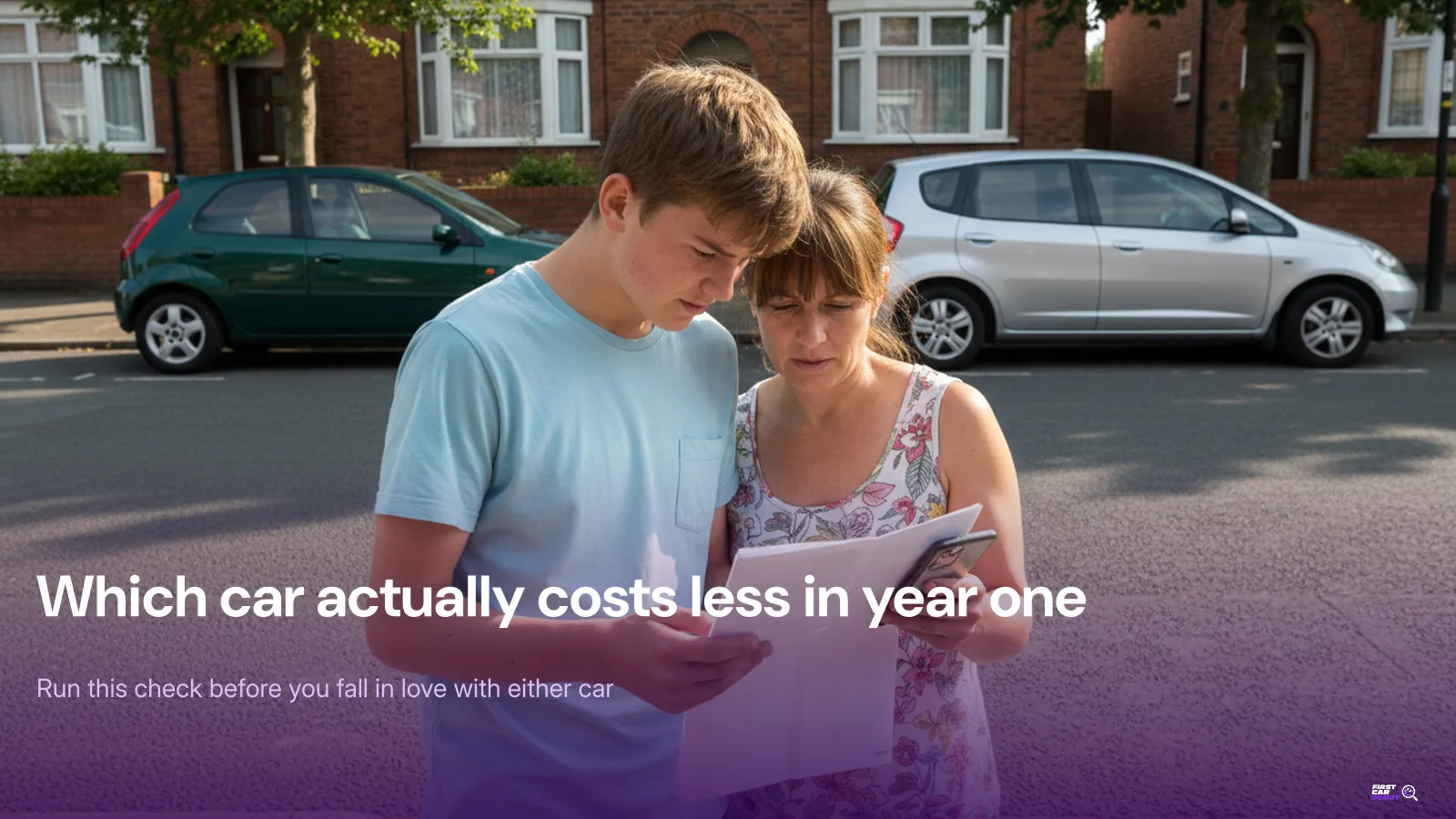
The break-even check: run this before you fall in love with either car
This is the step most buyers skip. Do it before you go to see the car, not after.
- Get the registration from the advert. Not the model name. The exact reg.
- Run a real insurance estimate on that specific reg. Comparison sites price by registration, not by model name, because trim and engine matter enormously. A sporty-looking 1.4 turbo and a base 1.0 non-turbo can share a badge and sit in completely different groups.
- Check the MOT history on GOV.UK (free). Look for recurring advisories, not just pass or fail.
- Look up the insurance group for that exact trim and engine via a specs or comparison site. Insurance groups (1 to 50) are set by Thatcham Research on behalf of the ABI Group Rating Panel. Do not use askMID for this: askMID checks whether a vehicle is currently insured on the Motor Insurance Database, which is a legal compliance check. It does not show insurance group ratings and cannot be used to compare running costs.
- Add fuel and road tax at realistic annual mileage.
- Add the purchase price. Now you have one number for each car.
When a reader on our platform compared two cars this way, one at £3,000 and one at £1,500, the cheaper car came out more expensive over 12 months once cover and repair risk were included. “Love a car, but worried about running costs? See the full picture before you fall in love.” That moment, before emotional commitment rather than after, is where this check earns its money.
When the cheap older car is still the right call, and when it isn’t
The older, cheaper car can still make sense when: it has a clean, consistent MOT history with no recurring advisories; it sits in a low insurance group for its age; a real estimate on the specific registration produces an affordable number; and the total year-one cost, calculated properly, genuinely comes out lower than the alternative.
The red lines where it doesn’t:
- Pre-2012 cars that comparison sites struggle to quote. Some older vehicles, particularly imports, unusual specs, or anything with a larger or modified engine, can become effectively uninsurable for a newly-passed driver at a sensible cost. One user described having a 2-litre Japanese import from 1995 as their first car and finding every quote “extortionate.” That is not a negotiation problem. It is the wrong car.
- High insurance groups relative to purchase price. If the annual cost of cover approaches or exceeds the car’s value, the maths do not work regardless of how good a deal the sticker price looks.
- No service history. Without it, you are guessing at the repair exposure, and that guess is usually optimistic.
“I’ve never spent this much on anything before, so I’m just so scared I make the wrong choice.” That anxiety is legitimate. The answer to it is not a badge recommendation. It is a number, built from the real registration, before you go to see the car.
Frequently asked questions
Is a car with a 4-star Euro NCAP rating really safer for a new driver than a cheaper older car with no rating? In a serious collision, yes, a rated car with modern crumple zones and multiple airbags offers measurable protection that an unrated older car does not. But Euro NCAP scores are only one part of new-driver safety. ESC, which reduces the chance of losing control in the first place, is arguably the higher-priority feature, and it became compulsory on new cars from 2014. A 2015 car with ESC and no NCAP rating may be a more practical choice than a 2005 car with a historic 4-star score but no stability control.
Does buying a newer car actually bring my insurance down, or is my age the main factor? Both matter, but they work differently. Your age and lack of claims history are the dominant factors insurers cannot be moved on. The car’s insurance group is the lever you can control. A newer car in a lower group genuinely produces a lower estimate than the same driver in a higher-group older car. The gap between group 3 and group 15 can easily be hundreds of pounds a year on a new-driver profile.
What year should a first car be from to get the best balance of safety, reliability, and insurance cost? Broadly 2015 onwards is where safety spec, common parts availability, insurance group, and MOT pass rates tend to converge into a meaningfully better proposition for most buyers. That said, the specific trim and engine matter more than the year alone. Always check the exact registration, not just the model and year.
Can I insure a car from 2005 or earlier as a new driver, and is it worth trying? Some older cars can be insured, but the combination of a pre-2006 vehicle and a newly-passed driver can produce very high estimates on standard comparison sites, and some specialist vehicles may be declined entirely. If you are set on an older car, try a specialist broker, not just a comparison site. But run the total year-one cost calculation first. In most cases, a few hundred pounds more on the purchase price buys a significantly cheaper and more predictable ownership year.