Black Box Insurance for Young Drivers: What Actually Happens After Year One
A black box cuts the cost of insuring your first car. But what happens when the year ends, and is it worth keeping? Here is what the numbers actually show.
The year-one deal and what comes after
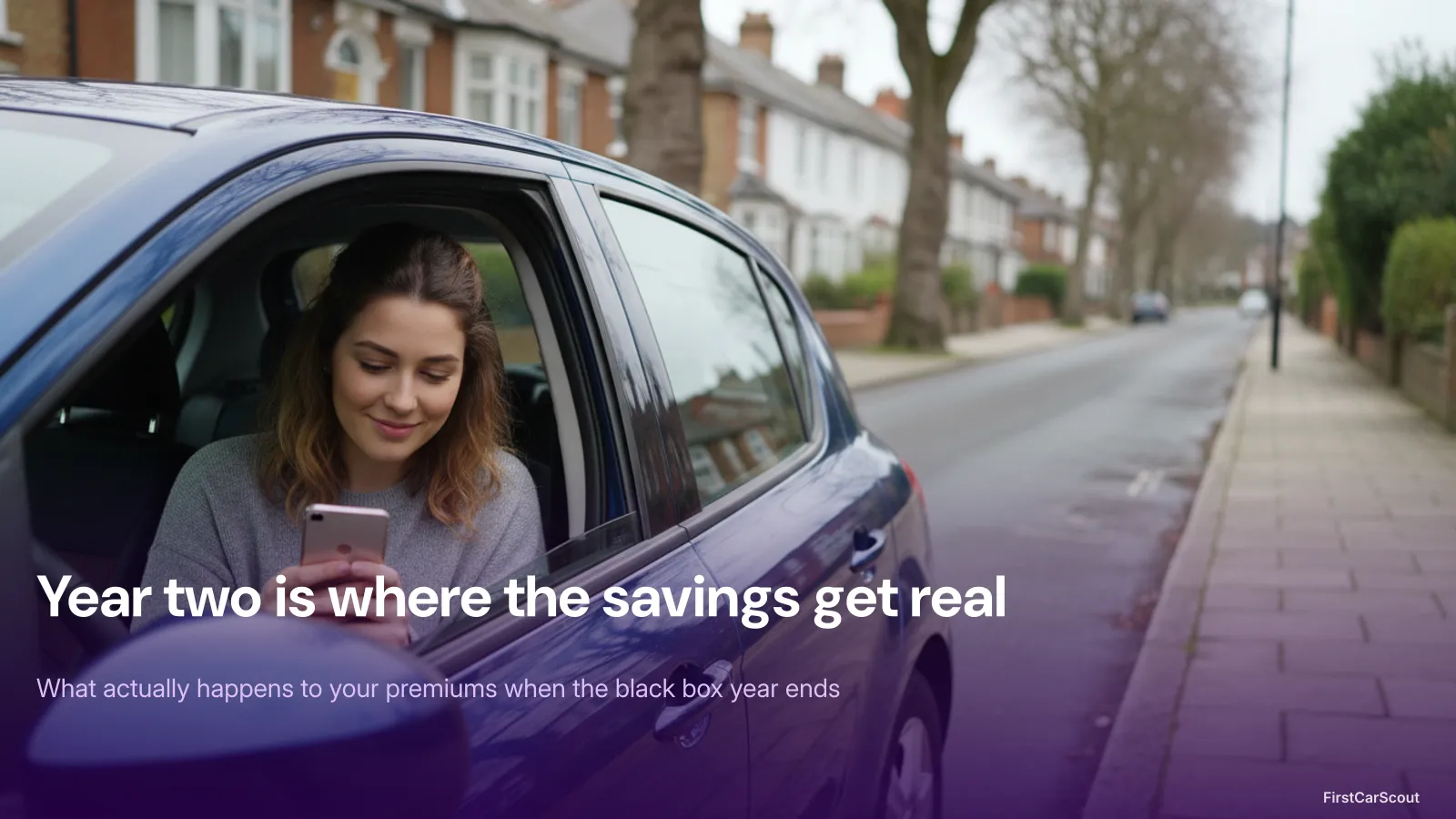
For most young drivers, the first year with a black box looks something like this: a big premium, a small box fitted to the car, and an app that scores every journey. It feels like being watched. For a lot of people it is genuinely worth it.
What is less talked about is what happens at renewal. One driver in our community summed it up well: first-year premium of £2,500 with a black box, renewal estimate of £700 with one year’s no-claims discount and a consistent score of 95 to 100. A drop of roughly 72%. Their insurer also told them they no longer needed the box at all.
That is not a fluke. It is how the system is designed to work.
Why the drop is so dramatic
Insurers price new drivers on statistics, not on the individual. At 17 or 18, with no driving history and no claims record, you are grouped with every other new driver. The numbers for that group are not good, which is why the premium is so high.
The black box changes the equation. Instead of pricing you on what young drivers in general do, the insurer can price you on what you specifically do: your speed, your braking, the time of day you drive. A full year of 95-plus scores is concrete evidence that you are not that statistical average. The renewal premium reflects that directly.
The no-claims discount compounds on top. After year one, you have one year’s NCD. After year five, most insurers apply a 65% discount as a baseline before any other factors come in.
Should you keep the box after year one?
This is the question that catches people off guard. If your insurer offers to remove it, should you take them up?
The honest answer is: get quotes both ways before you decide. Some drivers with clean scores find that keeping a telematics policy into year two still produces a lower premium than a standard policy, even with a year’s NCD. Others find the gap has closed enough that the freedom of a standard policy is worth a few extra pounds.
Two things to weigh up:
Without the box: no restrictions on late-night driving, no score to worry about, no app. If your lifestyle has changed since year one, this matters.
With the box: if your score has been consistently high, some insurers will keep the premium lower than they would on an equivalent standard policy. It is worth getting the actual number rather than assuming.
The renewal trap: your insurer’s figure is a ceiling
This is the most important practical point. Whatever figure your insurer sends at renewal, treat it as the starting position, not the answer.
With one year’s NCD and a clean record, you have genuine buying power. Run the comparison sites. Check direct with insurers who do not appear on comparison sites (some of the most competitive ones do not). The renewal estimate you receive is what your current insurer wants to charge. Another insurer looking at the same record may offer significantly less.
Several drivers in our community have found their renewal estimate cut further simply by shopping around, sometimes by several hundred pounds on an already-reduced second-year figure.
What if year one did not go as planned?
Not every driver ends year one with a 95-plus score. Black boxes measure real behaviour: harsh braking, late-night journeys, speed. If the score has been middling, the renewal drop will be smaller, and the insurer may not offer to remove the box.
That is still not a disaster. One year’s NCD still reduces your next premium meaningfully. A second year with improved scores compounds the benefit further. The system rewards consistency over time, not just a single good year.
If the score has been poor and the renewal estimate is still very high, this is the moment to look seriously at whether the car itself is part of the problem. Insurance group matters. A car in group 1 to 5 with a black box is a very different number from a car in group 15 with the same box.
The numbers that matter going into year two
Before you accept any renewal:
- Check what your NCD level is and whether it is transferable (it should be)
- Get quotes on comparison sites with the box and without
- Make sure the mileage you enter is realistic for your actual driving now (commuting changes this)
- Check whether adding a named experienced driver still makes sense or whether you are now the lower-risk person on the policy
Year one is the expensive part. Year two, done right, should feel noticeably different.