The Trim Level Trap: Why a Corsa Design Is Affordable to Insure, but a Corsa SRi Will Cost You
The same Vauxhall Corsa badge can span wildly different insurance groups depending on trim, engine, and power output. Here's exactly what changes, why it matters, and how to check before you fall for the wrong spec.
Same badge, completely different insurance bill
Search ‘Vauxhall Corsa’ on AutoTrader and you’ll find the same name on cars that sit in entirely different insurance groups. That single word, Corsa, tells an insurer almost nothing. What they’re actually pricing is the trim, the engine size, the power output, and how repair costs and claims history stack up for that exact version.
Take the Corsa range as a worked example. A 2016 to 2018 petrol Corsa in a standard trim sits at ABI insurance group 2, according to FirstCarScout’s verified vehicle data. Move to a higher trim with a turbocharged 1.0 or 1.4-litre engine and more power output, and the group climbs. The old Corsa VXR, with its significantly higher bhp, was a different world again. These aren’t minor differences. For a newly passed 18-year-old, moving several insurance groups upward can add hundreds of pounds to what running the car costs in year one.
The model name is almost irrelevant. What the insurer prices is the exact trim, engine, and power output of the specific car in front of them.
What actually changes between trims, and why insurers care
Several variables move when you go up through a trim range, and each one pushes the group higher.
Engine capacity and turbocharging. A naturally aspirated 1.0 or 1.2 petrol tends to stay in lower groups. Add a turbo or step up to a larger engine and the power output rises, which changes the risk profile directly.
Bhp. Higher power output is one of the most consistent predictors of a higher insurance group. It’s not the only factor, but it’s a significant one.
Trim-specific parts and repair costs. Sporty trims often include alloy wheels, body styling, upgraded interiors, and additional electronics. When any of these get damaged in a bump, they cost more to repair or replace than the parts on a base trim. Thatcham Research, which sets group ratings on behalf of the ABI Group Rating Panel, factors in repair costs as part of its methodology.
Theft desirability and claims frequency. Some trims attract more theft attempts than others. Some are driven, on average, by a younger profile of driver who makes more claims. Insurers price what they observe over thousands of claims, not what you plan to do.
Understanding this mechanism means you can apply it to any model you’re considering, not just the Corsa.
The sporty-looking trap: why ST-Line, SRi, FR, and similar badges are a signal to stop
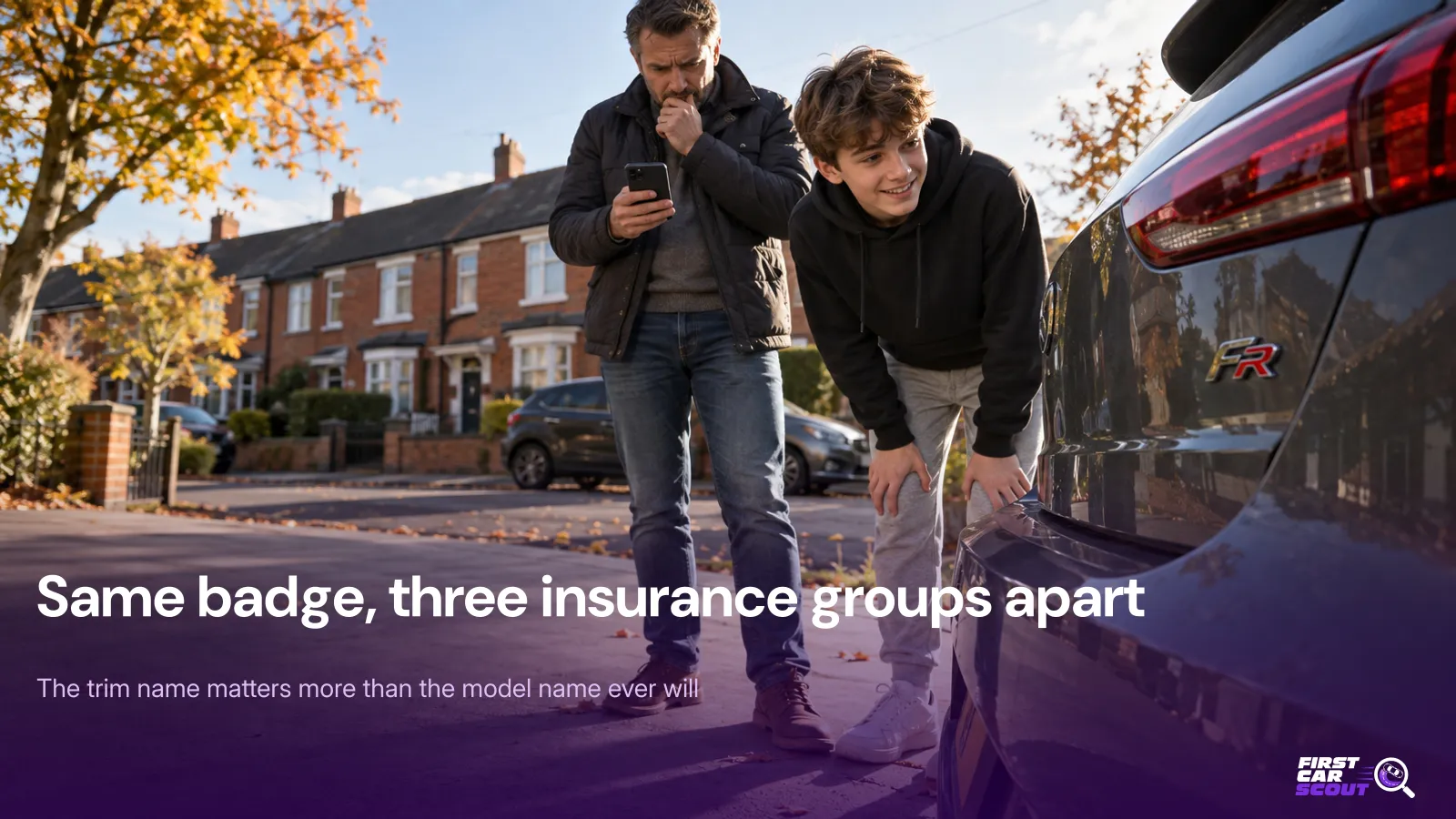
Manufacturers have become skilled at selling aspirational aesthetics without the full performance engineering. A Ford Fiesta ST-Line looks almost identical to an ST on a quick glance. A Corsa SRi shares plenty of visual DNA with the VXR. A SEAT Ibiza FR looks sharper than an Ibiza SE.
The problem is that insurers don’t price what the car looks like. They price the trim’s claims history, repair bill profile, and the driver demographic it attracts. Sport-appearance trims often follow almost the same group trajectory as the genuine performance versions, because the alloy wheels, styling parts, and lower-profile tyres push repair costs up in the same direction, and the theft and claims data reflects the badge regardless of what’s under the bonnet.
This pattern repeats across most mainstream brands. If you see SRi, ST-Line, FR, S line, R-Line, GT Line, or anything similar in an advert, that word alone is a signal to check the insurance group before anything else. It doesn’t mean the car is uninsurable. It means you need the actual number for that specific trim before you decide.
Check the exact registration before you fall in love with it
Two Corsas listed as ‘1.2 petrol’ on AutoTrader can return noticeably different results if one is a Design and one is an SRi. The engine displacement is the same; the trim, parts profile, and group rating are not.
Here’s the workflow that actually protects you:
- Get the registration number from the advert before you view.
- Look up the insurance group for that specific car using a specs or vehicle-data site. Insurance groups (rated 1 to 50) are set by Thatcham Research on behalf of the ABI Group Rating Panel. A comparison site run on the actual registration will also return this. Do not use askMID for this. askMID is the Motor Insurers’ Bureau’s tool for checking whether a vehicle is currently on the Motor Insurance Database, which is a legal compliance check. It does not provide group ratings and cannot tell you what a car will cost to insure.
- Run a full check on a comparison site using your real driver profile and the actual registration. Do this before you book a viewing.
- Only once those numbers work, go and see the car.
One user in our research described exactly the wrong sequence: falling for a car, buying it the same weekend, and discovering the running costs only afterward. Getting the registration first costs nothing.
How to get the car you actually want at a trim you can afford to run
The boring-trim version of a car you genuinely like is almost always the answer. A Corsa in a standard trim, a Fiesta in a base or mid spec, a Polo without the sport badge: these cars often look nearly identical to their sportier siblings on a casual inspection, they’re cheaper to buy, and they sit in materially lower groups.
One year of building a no-claims record on the right trim puts you in a genuinely stronger position at renewal. A parent in our community noted their teen’s premiums dropped significantly after a clean first year on a telematics policy. That first year of history is something you earn by picking the right car now, not by picking the coolest trim.
When scanning listings, the words to pause on are: trim name (does it include any sport designation?), engine size, power output in bhp or PS if listed, and whether a turbo is mentioned. Any of those that point toward a sportier spec is a reason to run the numbers on that registration before anything else.
FAQ
If two Corsas are both 1.2 petrol, why is one more expensive to insure? Engine displacement is one input, not the whole picture. The trim affects repair costs, parts prices, and claims history independently of the engine size. A 1.2 in an SRi trim has different alloys, body styling, and a different theft and claims profile than a 1.2 in a Design trim. Same engine, different group.
Does trim level affect the insurance group, or just the engine size? Both do, and they work together. A base trim with a large engine will be priced higher than a base trim with a small engine. But a sporty trim with the same small engine as a base trim can also sit in a higher group because of repair costs and claims data. Engine size alone doesn’t explain the whole difference.
I’ve already bought an SRi. Is there anything I can do? A telematics (black box) policy is the most direct lever for year one. It prices your actual driving rather than the group alone and is consistently the biggest single saving available to new drivers. Shopping across multiple comparison sites and adding an experienced named driver who genuinely uses the car are both worth doing. The group doesn’t change, but the total running cost can still be managed.
How do I find the insurance group for a specific car I’ve seen advertised? Ask the seller for the registration, then run it through a comparison site using your real driver details. A vehicle-spec or car-data site will also show the group. The registration is the only input that gives you the right answer for that specific car.