First Cars in Insurance Group 1: Which Ones You Can Actually Buy in the UK
Only a handful of first cars are genuinely in insurance group 1 and affordable. What each typically costs to buy, plus the popular cars that are really group 3 or 4.
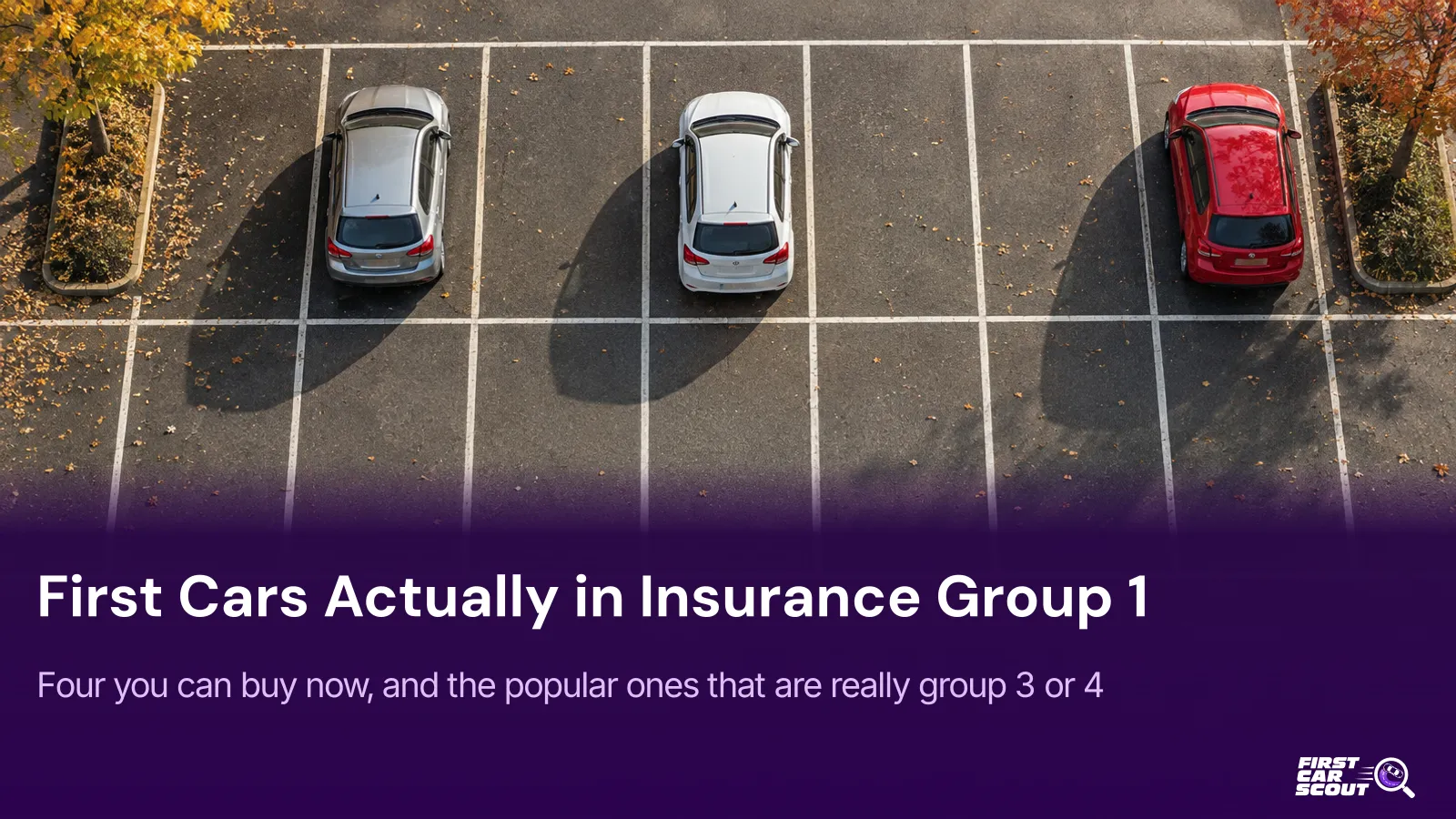
The short answer: very few first cars are genuinely in insurance group 1, and fewer still are affordable. Only four small petrol cars in group 1 are realistically affordable under about £8,000: the Volkswagen Up!, Skoda Citigo, Hyundai i10 1.0 and Nissan Micra 1.0. Several cars that are often called group 1 are usually group 3 or 4.
This page helps you narrow down which cars are worth looking at. It is not a list of exactly which car to buy. Prices are the range most used examples were advertised at in early October 2026, leaving out the cheapest and dearest oddities, so they are asking prices rather than what cars sell for. Groups are the usual group for that version of the car. They change with engine, trim and year, so always check the registration of the exact car.
The group 1 cars you can actually buy
| Car (petrol, manual) | Years | Typical asking price |
|---|---|---|
| Volkswagen Up! 1.0 | 2013 to 2020 | £3,500 to £5,500 |
| Skoda Citigo 1.0 | 2012 to 2016 | £3,750 to £4,500 |
| Hyundai i10 1.0 | 2015 to 2017 | £5,000 to £5,500 |
| Nissan Micra 1.0 | 2017 to 2019 | £7,000 to £7,750 |
The SEAT Mii is the Up! and Citigo under a third badge. The 2012 to 2017 Mii is usually group 2 (roughly £3,750 to £5,000), so it is one step above these but is often the cheapest of the three to buy.
Group 1 cars that cost more
Newer, lower-mileage group 1 cars exist, but they are outside most first-car budgets:
| Car (petrol) | Years | Typical asking price |
|---|---|---|
| Skoda Fabia 1.0 manual | 2017 to 2021 | £8,250 to £10,250 |
| Volkswagen Polo 1.0 manual | 2018 to 2021 | £10,500 to £12,500 |
| Kia Picanto 1.0 automatic | 2021 to 2025 | £11,000 to £12,500 |
| Hyundai i10 1.0 automatic | 2023 onwards | £13,250 to £16,000 |
If you want a newer car, a 2018 to 2021 Polo or a 2017 to 2021 Fabia is the realistic group 1 route.
Popular first cars that are not group 1
This is where “group 1” lists often mislead. These well-known first cars usually sit higher:
| Car | Usual group | Typical asking price |
|---|---|---|
| Toyota Aygo 1.0 (2008 to 2014) | 3 | £2,750 to £3,500 |
| Peugeot 107 1.0 (2010 to 2014) | 3 | £2,500 to £3,750 |
| Citroen C1 1.0 (2012 to 2013) | 3 | £2,750 to £3,000 |
| Fiat Panda 1.2 (2013 to 2019) | 3 to 4 | £3,250 to £4,000 |
| SEAT Mii 1.0 (2014 to 2018) | 4 | £4,000 to £6,250 |
| Dacia Sandero 1.0 (2017 to 2022) | 4 | £5,500 to £7,500 |
| Kia Picanto 1.0 manual (2011 to 2025) | 3 to 4 | £5,000 to £8,500 |
None of these is a bad choice. The Aygo, 107 and C1 are usually the cheapest cars to buy in this whole list, and group 3 is still a low group. But if a list tells you they are group 1, it is not matching what the registration data says, and the premium you are quoted may be higher than the list led you to expect.
Group 1 is a baseline, not a guarantee
The group is only one input to a young driver’s premium. In FirstCarScout’s September 2026 estimates for an 18-year-old driving 8,000 miles a year, a group 4 Volkswagen Polo (about £145 a month) was estimated cheaper to insure than a group 2 Skoda Citigo (about £155 a month). These are our own estimates for one standard profile, not insurer prices. The full comparison is in our guide to the cheapest insurance group cars for young drivers.
The number that matters most is the total monthly cost: premiums, fuel, road tax and servicing together. We rank cars on that in the FirstCarScout Car Finder. The next sections cover whether they are worth buying.
So are they worth buying?
For most new drivers, yes, with conditions. A group 1 car is the right place to start the search, but three things change the verdict:
- If you carry rear passengers. The Aygo, 107 and C1 are tight in the back. A Skoda Fabia (group 2, roughly £5,000 to £7,500 for the 2015 to 2019 1.0) or a Hyundai i10 gives more room for similar money.
- If you are drawn to the cheapest, oldest car. The Aygo, 107 and C1 ask roughly £2,500 to £3,750, but they are 2008 to 2014 cars, many with well over 50,000 miles on the clock. The price looks low until a clutch, a gearbox sensor or a catalytic converter shows up on the MOT sheet. Ask what the car costs to keep, not just to buy, and read the MOT history for repeated advisories.
- If your driver profile is the problem, not the car. Penalty points, a non-motoring conviction or a cancelled policy can make mainstream comparison sites decline you outright or return figures that bear no relation to the car’s value. A group 1 car is still the right vehicle, but the insurer is the thing to solve first: specialist brokers that cover drivers with points or convictions, and telematics-only providers, are the usual route.
Decide the car and the running costs together, not in sequence. Getting a realistic estimate for the exact registration before you commit is the single step that prevents most of the pain this decision creates.
Before you buy
- Check the exact car. Put the registration into the Check a Car tool to see its insurance group, an estimated monthly running cost and its MOT status before you view it.
- Compare more than one policy type. A black box (telematics) policy is often one of the biggest levers for a new driver, and fully comprehensive can cost less than third party.
- Read the MOT history. The free DVLA check at GOV.UK shows every pass, failure and advisory.
- Treat price and premium as one budget. Two cars in the same group can still differ by hundreds of pounds a year.
Common questions
Which first cars are in insurance group 1?
The petrol cars in group 1 that you can realistically buy under about £8,000 are the Volkswagen Up! (2013 to 2020, roughly £3,500 to £5,500), the Skoda Citigo (2012 to 2016, roughly £3,750 to £4,500), the Hyundai i10 1.0 (2015 to 2017, roughly £5,000 to £5,500) and the Nissan Micra 1.0 (2017 to 2019, roughly £7,000 to £7,750). Newer group 1 cars, such as the 2018 to 2021 Volkswagen Polo 1.0, typically ask over £10,000.
Is the Toyota Aygo in insurance group 1?
The 2008 to 2014 Toyota Aygo 1.0, and its twins the Peugeot 107 and Citroen C1, are usually group 3, not group 1. They are still low and usually the cheapest to buy, at roughly £2,500 to £3,750, but check the exact registration because groups vary by version and year.
How many cars are in insurance group 1?
Group 1 is the lowest of the 50 insurance groups, but very few affordable used cars sit in it. Only a handful of small petrol models in group 1 are realistically affordable under about £8,000: the Volkswagen Up!, Skoda Citigo, Hyundai i10 1.0 and Nissan Micra 1.0.
Does being in group 1 mean the cheapest premium for a new driver?
Not always. In FirstCarScout's September 2026 estimates for an 18-year-old, a group 4 Volkswagen Polo (about £145 a month) was estimated cheaper to insure than a group 2 Skoda Citigo (about £155 a month). Age, postcode, policy type and insurer all move the figure.
Is it better to buy a newer car in group 2 or 3 than an older car in group 1?
Often it is worth comparing both. A newer group 2 or 3 car with a clean service history and no MOT advisories can cost less over two years than an older group 1 car whose repair bills keep stacking up. Compare the asking price, the estimated monthly running cost and the MOT history together, not the group alone.
Will a group 1 car help if I have points, a conviction or a cancelled policy?
Not much. The car is rarely the problem: mainstream comparison sites may decline the driver outright or return figures that bear no relation to the car's value. Specialist brokers who cover drivers with points or convictions, and telematics-only providers, are the usual route, and a group 1 car is still the right choice once you have one.