Just passed your test? Do this cost check before you fall for any car
Most first-car guides hand you a badge list. This one walks you through the actual cost check to run on any specific car before you go to see it, so you don't discover unaffordable running costs after you've already fallen for it.
The sticker price is the smallest number you need to worry about
Here is the reframe that changes everything: for a newly passed driver, the annual cost of insuring the car routinely exceeds what the car itself cost to buy. One parent in our user research described getting quotes of around £3,000 a year for their newly qualified teen, up from £600 the previous year on a different arrangement. Another was seeing £275 to £615 a month for a 1-litre Hyundai.
Those figures are not outliers. They are what happens when you pick the car first and check the running costs second.
The real budget for a first car is: purchase price, plus first-year premiums, plus road tax, plus at least one service and a tyre or two. Treat that as one number before you fall in love with anything.
Why ‘get a Corsa’ is only half the advice
Every badge-list guide says the same things: Corsa, Yaris, Picanto, Fabia. They are not wrong, but they are incomplete.
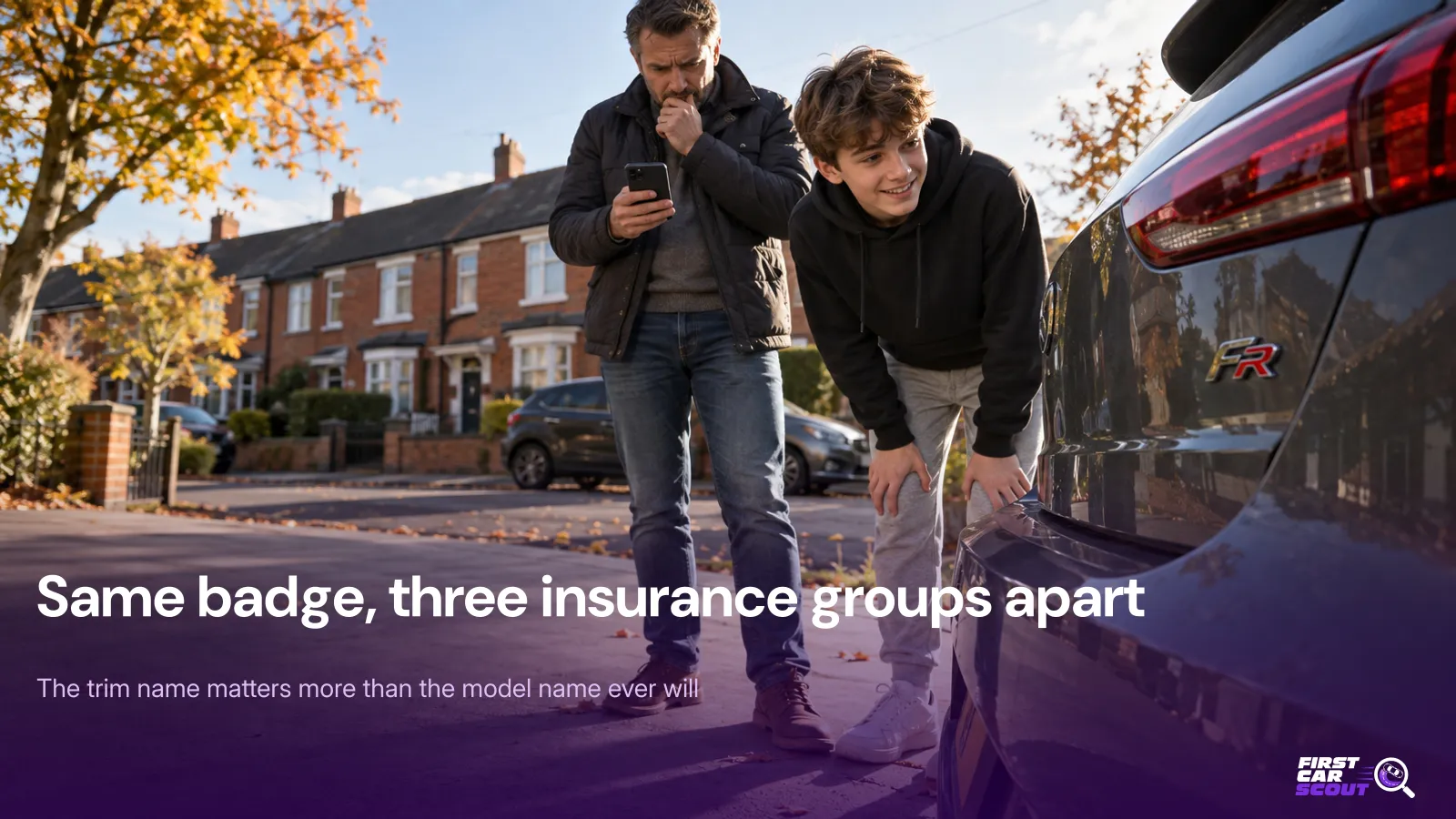
The same model name covers a wide range of insurance groups depending on the exact engine, trim, power output, and year. Insurance groups (1 to 50) are set by Thatcham Research on behalf of the ABI Group Rating Panel, and two cars wearing the same badge can sit several groups apart. A base Corsa with a small non-turbo engine is a very different insurance proposition from a turbo Sport trim in the same model range. The sporty-looking version of a common car often sits in a meaningfully higher group than the dull trim, and that gap translates directly into hundreds of pounds a year at new-driver rates.
The specific registration matters more than the badge. Until you have a reg, you do not have a car to evaluate.
The cost check to do before you go to see any car
This is the step most buyers skip, and it is the most important one.
- Get the exact registration from the advert before you do anything else.
- Check the free MOT history on GOV.UK. Look for recurring advisories, because patterns (repeated brake, tyre, or corrosion notes that never get fixed) are a proxy for hidden maintenance costs.
- Run an insurance estimate on that specific registration on a comparison site, not just the model name. The reg pulls the exact spec and the insurer prices the actual car. One user in our research asked: “Do you search for a new quote for every car that you see?” The answer should be yes, every time.
- Add up the real first-year number: purchase price, plus that insurance estimate, plus road tax for the specific vehicle, plus a realistic service cost. Only then decide whether it is worth driving to view.
A note on a common false shortcut: askMID (the Motor Insurers’ Bureau’s public tool) tells you whether a specific vehicle is currently recorded as insured on the Motor Insurance Database. It is a legal compliance check. It does not show insurance groups or give you any indication of what a car will cost to insure. For insurance groups, use a vehicle specs site or run an actual comparison-site estimate on the registration.
What actually makes a first car affordable to run
Four things move the number most:
Insurance group. The dull base trim of a common car consistently beats a sporty-looking one. Anything with GT, Sport, ST, VXR, or similar in the name is worth treating with caution until you have seen the actual estimate.
Engine size and type. Small non-turbo petrols (1.0 to 1.2 litre, naturally aspirated) generally land in lower groups and cost less to repair. A small-displacement turbo engine can look innocent on paper but sit in a higher group if it produces more power or has a history of claims from young drivers in that trim.
Service history and MOT advisories. These are the best available proxy for what the car will cost you in the next 12 months. A car with a clean, stamped history and no recurring advisories is worth more than a cheaper one with gaps.
Gearbox type if buying automatic. Automated manuals (Toyota MMT, Vauxhall Easytronic, VW ASG) behave very differently from a torque-converter or CVT automatic. They can feel jerky at low speed and carry a known repair cost if the clutch actuator fails. Always confirm which type you are buying and test-drive it in slow traffic before committing.
The one lever that moves the number most in year one
A telematics (black box) policy is the single biggest tool available to a new driver. Rather than pricing you purely on statistics for your age group, the insurer prices your actual driving behaviour: speed, smoothness, braking, time of day.
The comparison-site estimate you run in the cost check above is a ceiling, not a fixed price. A telematics policy in year one can come in meaningfully below that ceiling. More importantly, a strong first-year score is what earns a cheaper second year without the box, because you arrive at renewal with both a no-claims discount and a documented driving record. One driver in our research went from £2,500 in year one (with a box, 1.5-litre car, age 19) to £700 at renewal, with the insurer removing the box requirement entirely.
The first-year quote is a starting point. Telematics is the route off it.
After you buy: the first things to sort before you drive away
Three things most buyers get wrong at the final stage:
Confirm your cover is active before collection, not just arranged. Several buyers in our research discovered only on collection day that their policy had not yet started, or that same-day activation required a phone call. Check the exact start date and time before you hand over money.
Check ULEZ compliance by actual registration if you are driving in or near a London clean air zone. Do not assume from the year or engine size alone. The official TfL checker takes a registration and gives a definitive answer.
Know when the MOT and next service are due. A car sold with an MOT valid for one month is a very different purchase from one with ten months remaining. Factor the likely cost into your first-year total before you commit.
Quick answers to questions we hear often
Does the insurance group stay the same across all versions of a model? No. It varies by engine, trim, power output, and year. Always check the group for the specific version you are considering, not just the model name.
Is fully comprehensive really cheaper than third party for new drivers? Often, yes. Third-party-only policies tend to attract higher-risk drivers, so insurers price that group up. Always compare all three levels rather than assuming third party is the budget option.
Can I drive the car home on the day I buy it? Only if your cover is confirmed active for that vehicle before you leave. Arrange this explicitly and check the policy start time, not just the start date.
Will premiums drop after year one even without a claim? Generally yes, especially on a telematics policy with a strong score. A clean first year builds a no-claims discount and a driving record that both feed into the renewal price. It is not guaranteed, but it is the consistent pattern.