The Best First Cars If You Refuse to Drive with a Black Box
Refusing a black box is a legitimate choice, but it shifts all the cost-control work onto the car itself. Here is how to pick the right spec, not just the right badge, when telematics is off the table.
What refusing a black box actually means for your budget
A black box does one specific financial job: it lets an insurer price you as an individual rather than as a statistical 18-year-old. Without one, the car carries that entire burden. Engine size, insurance group, trim, and power output become the only levers you have left. That is not a moral judgement on the decision, it is just the arithmetic. One user summed up the underlying anxiety well: “I waited my whole life for this, I’m not giving it up in year one.” Fair enough. But opting out without adjusting the shortlist is where the real cost lands. The car you choose without a box needs to do more work than the same car would with one, so the shortlist genuinely has to be different.
Why the model name is the wrong thing to search for
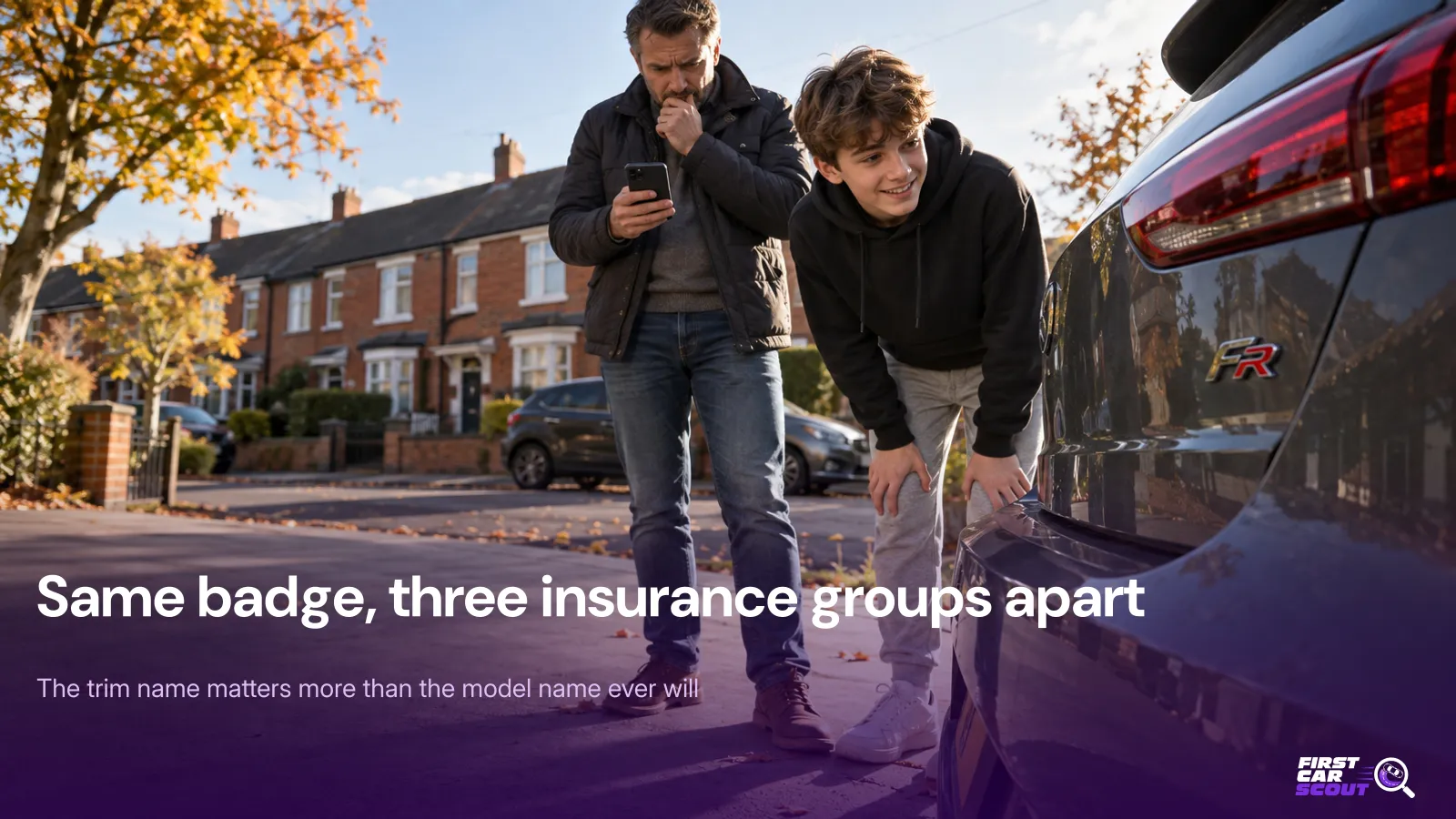
Searching for “a Corsa” or “a Fiesta” is not searching for one insurance price. The same badge can span a wide range of insurance groups depending on engine size, trim, power output, and whether the engine is turbocharged. One first-timer described getting estimates of £4,000 to £5,000 for cars that were supposed to be affordable, with no idea which variable was driving it. The answer is almost always trim or engine. A 1.0-litre naturally aspirated Fiesta in a base trim sits in a completely different group from a 1.0 EcoBoost ST-Line, even though both say “1.0” on the advert. Without a black box compressing those group differences through behavioural data, a sporty trim of a supposedly sensible car can cost as much to run as a premium badge in a base trim. The decision that matters is spec-level, not model-level.
The car characteristics that absorb the no-black-box penalty
Without telematics, the variables that keep premiums survivable are specific:
- Insurance group 1 to 5. The lower the group, the less the absence of a black box hurts.
- Sub-1.2 litre, naturally aspirated engines. A turbo can push a small engine into a noticeably higher group even at modest power outputs.
- Base or mid trim only. Anything badged ST, GT, Sport, R-Line, S line, VXR, or equivalent carries a higher group and often a higher theft-claim rate.
- Common, cheap parts. Repair cost is one of the inputs Thatcham Research uses when assigning insurance groups, so cars with widely available, inexpensive parts tend to sit lower.
Real examples that consistently appear at the sensible end: the Hyundai i10 (2016 onwards, base or mid trim, 1.0 or 1.2 petrol), the Kia Picanto (2017 onwards, 1.0 non-turbo), the Volkswagen Up (1.0, non-turbo), and the Skoda Citigo (group 1 to 2 depending on trim and year). These figures come from insurance group databases rather than individual estimates, so verify the exact registration’s group before committing, as model-year facelifts occasionally shift a car between groups.
Check this before you fall in love with it
The workflow for a no-black-box buyer has to start with the insurance figure, not end with it. In practice:
- Find a specific car with a specific registration on the listing.
- Look up that registration’s insurance group via a vehicle specs or insurance group tool. Note: askMID (the Motor Insurers’ Bureau’s public checker) tells you whether a car is currently insured, not what group it sits in. It cannot be used to check insurance groups.
- Run fully comprehensive estimates on a comparison site using that registration. Fully comprehensive is often cheaper than third party for new drivers because the third-party pool skews higher-risk, so always compare all three levels rather than assuming third party is the affordable option.
- Add the car price and the first-year premium together and treat that combined figure as one number against your total budget. The car and the cover are not two separate decisions.
If the combined number does not work, do not view the car. Falling in love with it first is how people end up post-purchase on forums asking “I bought my dream car. Now what do I do?”
The aspiration gap: can you have something less generic without being punished
Many readers refusing a black box are also the ones who do not want an Aygo. That tension is real and worth addressing honestly. There is some room: the Mazda 2 (1.5 naturally aspirated, base or SE trim), an older Volkswagen Polo (pre-2017, 1.0 non-turbo), the SEAT Ibiza in a base trim, and the Honda Jazz all sit in tolerable groups for non-telematics buyers. The Jazz in particular offers genuinely useful interior space without a punishing group, which makes it a sensible step up from the city-car tier.
The wall appears quickly, though. A Honda Civic, even an older one, tends to quote significantly higher. Anything with a sporty badge or trim regardless of engine size tends to sit in groups that are hard to absorb without telematics as a buffer. One user’s research found that a Honda Civic sat outside what a first-car budget could carry. That is a spec and group problem, not a reliability problem.
What to expect at renewal, and when the no-black-box penalty shrinks
Year one without a black box is the worst it gets. One clean year of no-claims history starts to replace what behavioural data would have provided. The pattern from real user evidence is encouraging: one driver on a Hastings telematics policy went from £2,500 in year one to £700 at renewal after a consistently strong driving score, and was told a box was no longer required. That is an unusually large drop and reflects both a good score and a specific insurer’s approach, so treat it as an illustration rather than a guarantee. What it does confirm is that the no-black-box penalty is not permanent. A clean year builds real no-claims history, and that compounds at each renewal regardless of whether a box was ever fitted. The one-year commitment is finite, not a life sentence.