Best First Car for a 17 Year Old in the UK: How to Check the Real Cost Before You Fall in Love
Most first-car guides hand you a badge list and leave you to discover the sting later. This guide teaches the workflow: check the exact registration before you view, understand why two cars wearing the same badge can cost hundreds apart to run, and treat purchase price plus year-one premiums as a single budget.
Why the sticker price is only half the story at 17
The car was £3,000. The running costs were not.
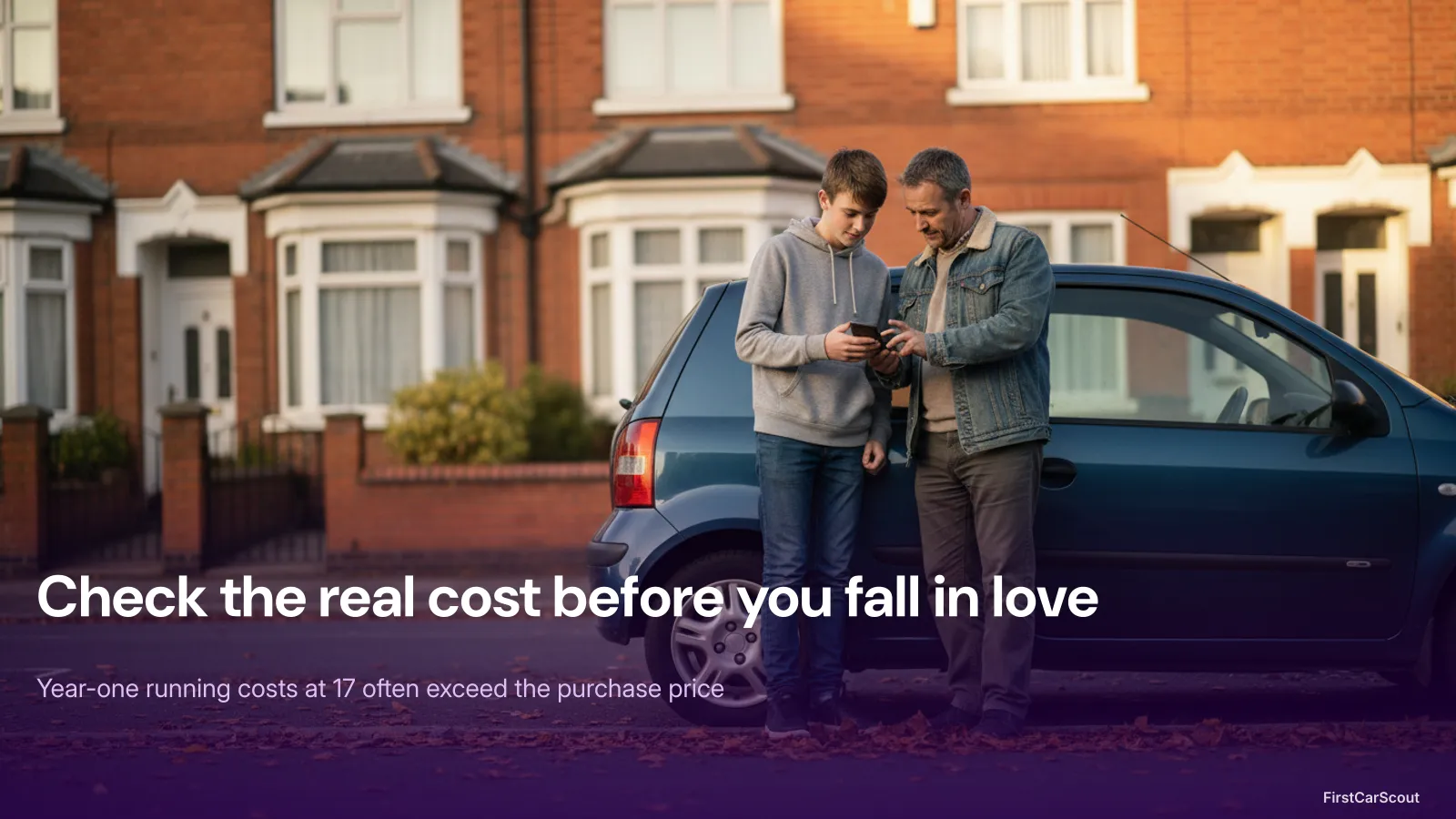
For a newly passed 17-year-old, year-one premiums frequently exceed the purchase price of the car itself. That is not a scare tactic, it is the single most consistent thing our user research surfaces. One teen told us: “Insurance costs twice the value of the car, before you fall in love with it.” Another: “Just about to get my licence, will my dream car bankrupt my insurance?”
The question at 17 is never just “what can I afford to buy?” It is “what can I afford to buy and insure together, as a single number?” Everything else in this guide follows from that framing.
Why the same model can cost very differently to run
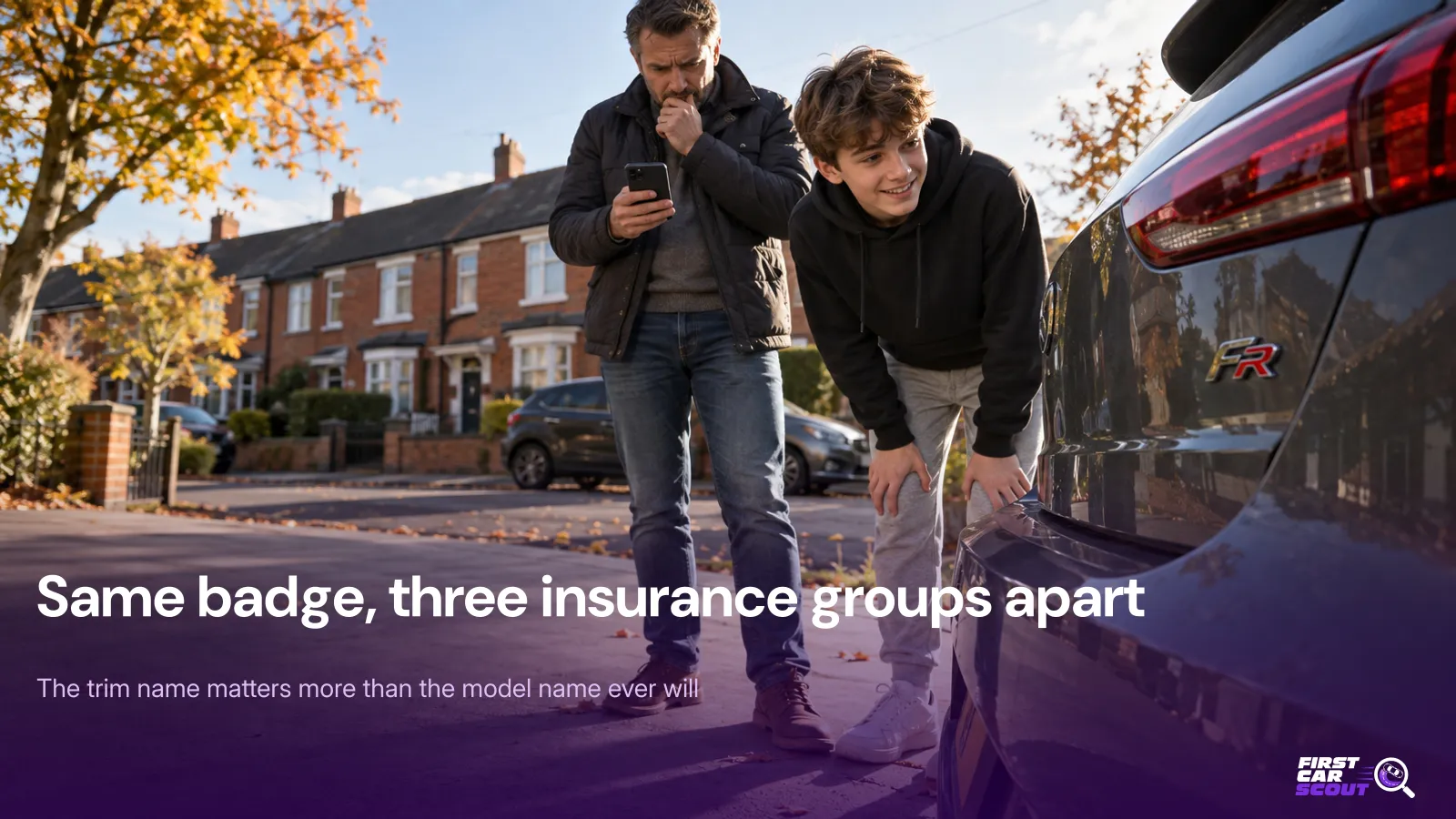
Here is the thing generic badge lists never tell you: insurers price the exact car, not the model name.
A 1.0 non-turbo base-trim Corsa and a 1.2 turbo Sport-trim Corsa are not the same insurance risk. Engine size, power output, whether there is a turbo, trim level, and gearbox type all shift the insurance group significantly. Insurance groups run from 1 to 50, set by Thatcham Research on behalf of the ABI Group Rating Panel. A car in group 3 and a car in group 18 can wear the same badge on the bonnet.
When someone online says “get a Fiesta” or “get a Corsa,” that is half an answer at best. The boring 1.0 base trim of either can be a genuinely sensible first car. The sporty-looking version of the same model, with a bigger engine, sport trim, or turbo, can price completely differently. The badge is not the answer. The specific version is.
Check the real cost before you fall in love with it
This is the step most buyers skip, and it is the most common source of post-purchase regret.
The workflow, in order:
- Find a specific listing with a full registration number.
- Run the registration through a comparison site (Compare the Market, MoneySuperMarket, Confused, GoCompare) as a newly passed 17-year-old, before you go to see the car.
- Look up the insurance group for that specific car via a vehicle specs or insurance-group lookup tool. Note: askMID, the Motor Insurers’ Bureau’s public tool, only tells you whether a vehicle is currently insured on the Motor Insurance Database. It does not provide insurance group ratings and must not be used for that purpose.
- Add the purchase price and the year-one premium estimate together. That combined figure is your real first-year cost.
Do this before viewing. Not after. Emotional attachment is real, one user told us: “The car I’d wanted since I started learning, no way I was leaving it.” The workflow only protects you if you run it cold.
What to look for in the car itself: spec, engine, and gearbox choices that matter
For a 17-year-old on a real budget, the sharper financial decision is almost always the duller trim of the right model.
Engine: Lower-powered, non-turbo petrol engines (typically 1.0 or 1.2, non-sport) tend to sit in lower insurance groups and cost less to repair. A turbocharged 1.0 or 1.2 can look harmless on paper but may sit several groups higher depending on power output and trim.
Trim: Anything with ST, ST-Line, S Line, R-Line, GT, VXR, or similar in the advert is almost certainly a higher group. Base and mid trims of the same car are usually the financially smarter pick.
Gearbox: If you hold an automatic-only licence, you cannot legally drive a manual, so verify the gearbox type on every listing. Also be aware that some cars sold as “automatic” are actually automated manuals (sometimes called AMT, Easytronic, or Multimode). These can feel jerky at low speed and are not the same as a smooth torque-converter automatic. Take any auto for a proper test drive in slow traffic before committing.
How to bring the premium down without changing the car
These are the real levers available before and after purchase:
Black box (telematics) policy: The single biggest tool for a 17-year-old. Premiums are based on how you actually drive rather than just your age and licence tenure. One user reported a first-year premium of around £2,500 on a black box policy, dropping to roughly £700 at renewal after a consistently high driving score, a real trajectory, though individual results vary by insurer, car, and driving record.
Named driver: Adding an experienced driver who genuinely also uses the car can lower the average risk profile. Never list them as the main driver when you are the primary user, that is called fronting, it is fraud, and it voids the policy if you claim.
Pay annually: Monthly payments are effectively a loan. Paying upfront for a 12-month policy avoids the interest loading.
Fully comprehensive: Counterintuitively, fully comp is often cheaper than third party for new drivers, because the third-party-only pool skews toward higher-risk profiles. Always compare all three cover levels rather than assuming third party is the affordable option.
Before you hand over any money: what to check on the specific car
Pre-purchase checks that matter at this budget:
- MOT history: Free via GOV.UK using the registration. Look for recurring advisories on corrosion, suspension, brakes, or emissions, these are patterns, not one-offs.
- HPI check: A paid check (around £20) confirms whether the car has outstanding finance, has been written off, or has a clocked mileage flag. Do not skip this on a private sale.
- Service history: Gaps matter. On older cars, a stamped service book or verifiable dealer history is a real signal of how it has been looked after.
- Gearbox condition: On the test drive, pay attention to how any automatic pulls away in slow traffic. Jerkiness or hesitation can indicate wear or a fundamental AMT design that will not improve.
- Policy conditions: One user discovered their policy had been cancelled without notification, only finding out after a collision. Read the policy document before, not after, you need it. Check cancellation triggers, mileage limits, and, critically, whether your licence type (manual or automatic) matches what the policy records.
Common questions
Is it true that premiums on a first car can cost more than the car itself?
Yes, at 17 with no driving history this is a common outcome, not a worst case. Treat purchase price and year-one running costs as one combined budget from the start.
Does it matter whether I hold a manual or automatic licence?
Yes. An automatic-only licence means you cannot legally drive a manual car. Some policies also specify licence type, a mismatch can be a cancellation trigger, as our research shows buyers have discovered the hard way.
Will a black box actually save me money, and can I remove it later?
For most 17-year-olds, a black box policy is the most significant premium reduction available in year one. Removal eligibility and renewal terms vary by insurer, so check these before you buy the policy, not after.
Why am I getting no estimates at all, or estimates that seem impossibly high, for what looks like a sensible small car?
A few things cause this. Conviction history, certain postcodes, and some car types (older imports, high-power engines, unusual models) can result in mainstream comparison sites returning no results at all, or figures that bear no relation to the car's value. This is a comparison-site limitation for that specific risk profile, not a signal that the car itself is a bad choice. If mainstream comparison sites fail you, specialist brokers exist for conviction history and for unusual vehicles. If the car itself is the problem, the honest answer is usually to change the car.