Automatic or Manual First Car: Which Should You Choose
Choosing between automatic and manual isn't just about what feels easier. It depends on your licence, your local market, and the cars your budget can actually reach. Here's how to think it through.
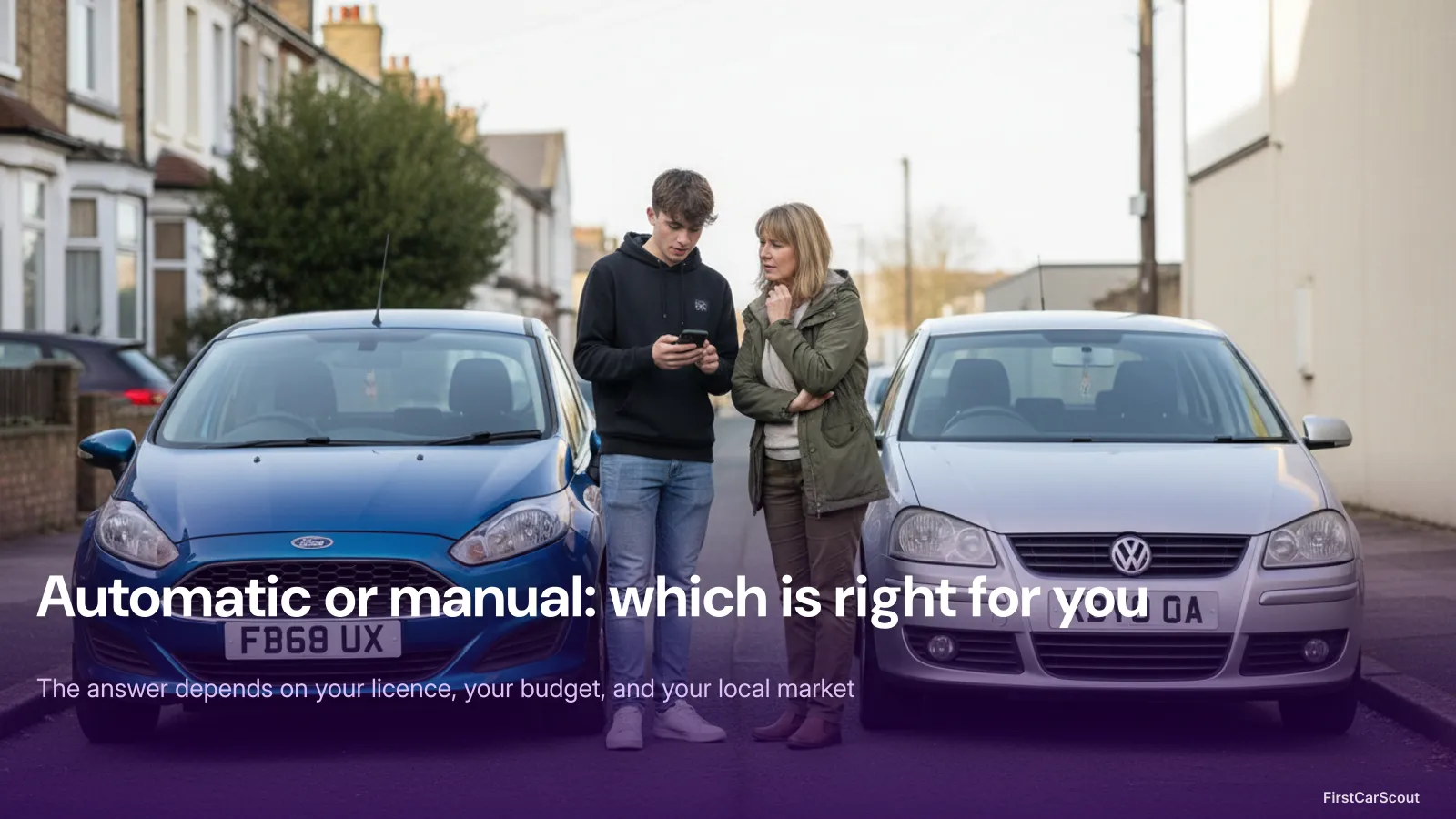
The first big decision isn’t the car. It’s the gearbox
Most first-car searches start with a make, a model, or a colour. But there’s a more fundamental choice sitting underneath all of that: automatic or manual? And it’s one that can quietly shape everything else, from which cars you can legally drive, to what you’ll pay to run them.
The right answer isn’t the same for everyone. It depends on your licence, where you live, and what the market in your area can actually offer at your budget.
What your licence actually allows
If you passed your test in a manual, you can drive both. Simple.
If you passed in an automatic, you are restricted to automatics only. This is a harder limit than most people realise. You cannot drive a manual on a full UK licence earned in an automatic car, so any listing you look at needs to match your licence type before anything else.
This comes up constantly in real first-car searches. One buyer who passed their automatic test near Edinburgh and was looking at city cars found that some listings described as automatics were actually AMT gearboxes, robotised manuals with a different badge. Worth double-checking every listing before you get attached to it.
Why the gearbox type matters more than automatic versus manual
Once you are looking at automatics, the type of automatic matters a lot.
Not all autos are equal. There are three to know:
- Torque-converter automatics: the traditional smooth auto, found in older Japanese cars and many larger vehicles. Reliable and unfussy.
- CVT (continuously variable transmission): used by Honda, Nissan, Suzuki and Toyota hybrids. Very smooth, efficient, and cheap to run.
- AMT (automated manual transmission): also called a robotised manual. This is what hides behind names like Toyota MMT, VW ASG, and some Kia Picanto auto variants. It behaves like a manual with the clutch pedal removed, and can feel jerky and hesitant at low speed.
Buyers who want a smooth automatic experience should actively avoid AMTs. The Toyota Aygo MMT and VW Up ASG are the two that trip people up most often, and both are common on the UK used market in first-car price ranges.
The manual case: still the default for most budgets
If you have a full manual licence, here is the honest reality: the affordable used car market in the UK is still dominated by manuals.
Below £4,000, the majority of small reliable hatchbacks, your Fiesta, Fabia, Picanto, Aygo, i10, are manual. You get more choice, more examples to compare, and more leverage on price. Supply is simply higher.
For buyers on a £2,500 budget looking for a reliable low-maintenance first car, the manual market is where the value is. A 2012 Skoda Fabia, a Honda Civic from the mid-2000s, a Hyundai i10: all are more plentiful and better priced in manual form.
The automatic case: real, but you need the budget
Automatics make total sense as a first car. But the good ones cost more, and the budget has to account for that.
A genuine smooth automatic in the £4,000 to £5,000 range is findable, but you need to know what to look for. Based on what buyers in this space are actually finding:
- Suzuki Swift CVT (2010 to 2012): often overlooked, which keeps prices honest. Proper CVT, reliable, low insurance groups.
- Toyota Yaris hybrid (2019 onwards): the e-CVT is as smooth as it gets, reliability is exceptional, and some examples are now entering this price bracket. Worth prioritising if you can find a clean one.
- Honda Jazz CVT: famously practical interior, very strong reliability, starting to come into range around £4,500 to £5,000.
- Nissan Note (2014 onwards): traditional automatic, practical, unfashionable enough that prices stay sensible.
At £8,000 to £10,000, the options open up significantly: Corolla hybrid, Kia Niro, Honda HR-V. But for the majority of first-car budgets, the list above is the realistic one.
Running costs: where the gearbox choice really lands
For most first cars, the difference in premiums between an automatic and a manual version of the same model is small, often marginal. The bigger driver of what you pay in year one is the insurance group, the engine size, and your age, not the gearbox.
Where automatics can cost more to run is on maintenance. AMT and DSG gearboxes need specialist servicing and can be expensive when things go wrong. CVT and torque-converter autos in Japanese cars are generally far cheaper to live with.
Fuel economy is roughly similar at first-car speeds and distances, unless you are in a hybrid, where the automatic e-CVT is genuinely more efficient.
How to decide
Start with these three questions:
- What does your licence allow? If it is automatic-only, that decides it.
- What is your real budget, car plus running costs combined? Below £3,500, manual gives you far more choice. Above £4,500, a genuine smooth automatic is findable.
- Where are you based? Markets vary. A buyer near Edinburgh found the typical city-car automatics overpriced by demand, and found better value in less fashionable models. Your local AutoTrader results matter.
The gearbox question is not about what feels easier. It is about matching the right transmission to your licence, your budget, and the actual cars available to you. Get that right first, then choose the car.
Not sure where to start? Try the FirstCarScout shortlist tool and filter by transmission type to see what fits your budget in your area.