What Actually Happens During the UK Practical Driving Test
A clear walkthrough of every stage of the UK practical driving test, what examiners are really looking for beneath the checklist, and why understanding the test structure helps you choose a smarter first car.
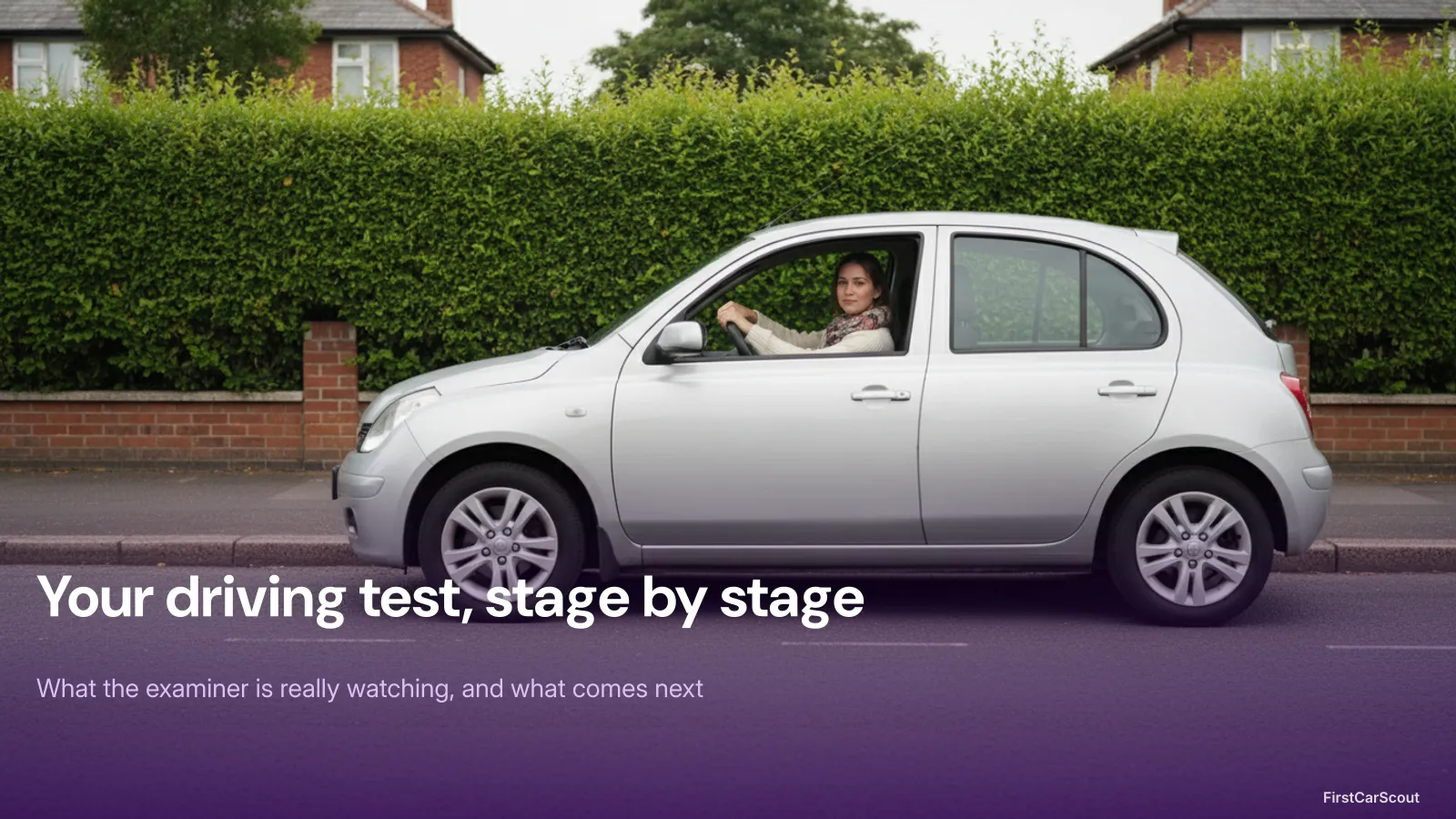
What the test actually looks like from start to finish
The practical test has four official stages, and knowing the order removes a lot of the nerves.
Eyesight check. Before you get near the car, the examiner asks you to read a number plate from 20 metres. Fail this and the test ends immediately.
‘Show me, tell me’ questions. Two vehicle safety questions. The ‘tell me’ question comes before you drive (you explain something verbally, such as how you’d check tyre pressure). The ‘show me’ question is asked while driving (such as switching on the rear demister). A wrong answer counts as one minor fault, not an automatic fail.
General and independent driving. The bulk of the test, roughly 35 minutes of driving. About 20 minutes of that is independent driving, where you follow either a sat nav or road signs without prompting from the examiner. You may also be asked to pull over and move off, or carry out an emergency stop.
Reversing manoeuvre. One of three set manoeuvres: parallel park, pull up on the right and reverse back two car lengths, or reverse out of a bay. The examiner chooses which one.
The full appointment takes around 90 minutes when you include check-in, the result, and any debrief. Cost is £62 on weekdays, £75 on evenings, weekends, and bank holidays.
What the examiner is really assessing, and why it’s harder than it sounds
Most candidates know the stages. What catches people out is not understanding what the examiner is actually watching for beneath them.
The test is not a checklist of actions. It is an assessment of four underlying competencies: observation, decision-making, hazard response, and the ability to navigate independently while managing everything else at the same time.
You are allowed up to 15 minor (driving) faults before you fail. A single serious or dangerous fault, however, ends the test immediately. The distinction matters: a minor fault is a lapse in an otherwise controlled situation. A serious fault is a mistake that could have caused real danger. Candidates often describe post-test shock because they felt in control throughout, without realising that one moment of poor observation or a hesitant junction decision crossed into serious territory.
To answer a common question directly: yes, you can fail during the independent driving section. Making a wrong turn does not count as a fault. But if the error causes you to pull out unsafely, brake sharply, or make a poor decision under pressure, that is what the examiner records.
On the automatic licence question: if you take the test in an automatic, your licence restricts you to automatics only. You cannot legally drive a manual on that licence. This is not a minor detail, it affects every car you can insure and drive after you pass.
The independent driving section is the closest thing to real driving
This is the segment most candidates underestimate, and for good reason: it is genuinely different from the rest of the test.
For roughly 20 minutes, you follow a sat nav (provided by DVSA) or road signs without instruction. The examiner watches how you make decisions, not just whether you execute them correctly. You are expected to read junctions, anticipate other drivers, hold your own speed, and navigate, all simultaneously.
This is exactly what new drivers face every day after passing. The gap between test-trained driving and independent real-world driving is real, and the independent section is designed to surface it. One user described the post-pass reality plainly: “It’s been 2 months since I passed my test. I don’t have anyone else to take me out to practice.”
The section is also where car familiarity matters most. A driver who has only ever sat in an instructor’s car may find that test day in a different vehicle introduces unexpected surprises. One new driver put it directly: “I had no idea how different driving a normal petrol automatic would be.” That unfamiliarity does not disappear once the test ends.
Passing your test is just the start: your first car choice changes everything
The skills the test demands, hazard awareness, vehicle control, independent judgement under pressure, directly inform what kind of car a new driver can confidently and affordably handle.
This is where the decisions get expensive. The pattern our research surfaces repeatedly is straightforward: new drivers fall in love with a car before understanding what it will actually cost to run. The purchase price is visible. The running costs, particularly premiums, are discovered later, often after the emotional attachment is already set.
“Insurance costs twice the value of the car, before you fall in love with it” is not a hypothetical. It is something real buyers describe. One parent saw a 300 percent increase. Another was quoted figures that made a sensible-looking £4,000 car cost over £3,500 a year to cover.
The car you take your test in does not restrict what you can drive afterwards (assuming a full manual licence), but it does shape your early confidence. A first car that suits your actual driving ability matters as much as one that suits your budget on paper.
What parents and new drivers consistently get wrong after the test
Three mistakes come up in our research more than any others.
Falling in love with the car before checking what it costs to run. “Just about to get my licence, will my dream car bankrupt my insurance?” is a question that should be asked before viewing, not after purchase.
Assuming a cheap car means affordable running costs. Engine size, trim level, insurance group, and postcode all affect premiums independently of the purchase price. A car in group 1 and the same car in a sportier trim can differ by hundreds a year for a new driver.
Discovering policy conditions only when something goes wrong. “I fully thought I was insured but had no notification my insurance was cancelled” describes a situation where the policy had been voided, and the driver found out only after police contact. The conditions that can trigger cancellation, occupation, incident history, even a data-entry mismatch on activation, are rarely explained clearly at the point of purchase.
The honest advice a knowledgeable friend gives is this: treat the car price and first-year running costs as one combined number. Check what a specific car actually costs to insure before you view it, not after you have decided you want it.
FirstCarScout builds a shortlist around exactly this, matching real UK listings to insurance cost, reliability data, and MOT history in one place, so the running-cost reality comes before the emotional attachment, not after.
FAQs
How many minor faults are you allowed before you fail? Up to 15. A 16th minor fault, or any single serious or dangerous fault, results in a fail.
Can you fail during the independent driving section? Yes. A wrong turn is not a fault, but the decisions you make as a result of it are assessed normally.
Does taking the test in an automatic affect your licence? Yes. Passing in an automatic restricts you to automatics only. To drive a manual, you must pass again in a manual car.
Does the car you take your test in affect what you can drive afterwards? Not directly, but the automatic or manual distinction on your licence does. The car itself does not carry over as a restriction.