Why more driving lessons don't always fix a failing test
Booking more lessons after a test failure feels like the obvious move. It often isn't. Here's how to work out what's actually going wrong before you spend another penny.
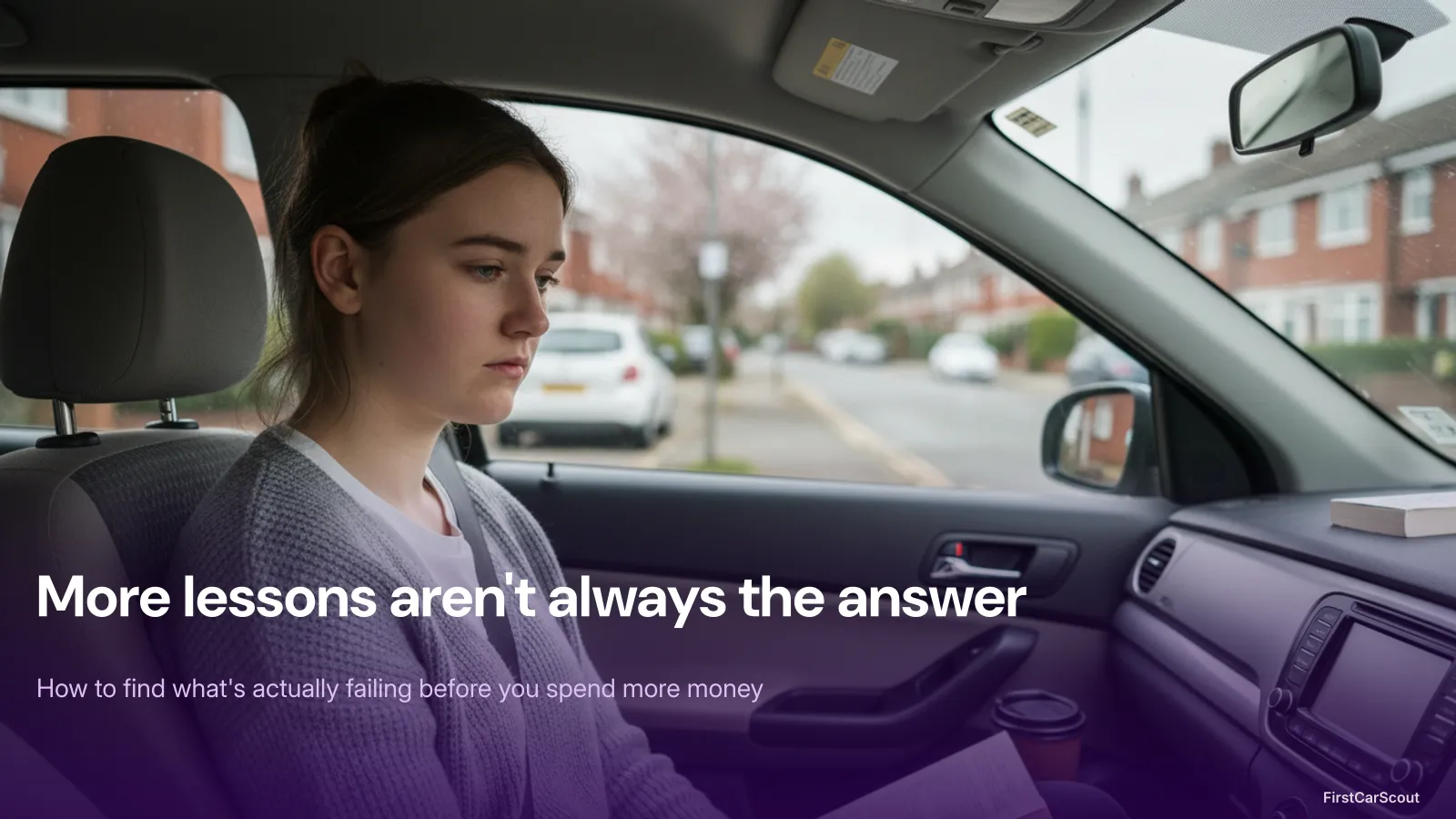
You failed your test. Or you passed, but only just, and everyone involved knew it was close. The instinct is to book more lessons. It feels productive. It feels like doing something.
Sometimes it’s exactly right. Often it isn’t.
More hours in a car fixes a skills gap. It doesn’t fix a confidence gap, a nerves problem, or a weakness that your instructor hasn’t identified yet. Before you spend another few hundred pounds on lessons, it’s worth being honest about which problem you actually have.
The difference between a skills gap and a pressure gap
A skills gap means you genuinely cannot do something yet. You’re not reading junctions cleanly, your manoeuvres aren’t consistent, your mirror-signal-manoeuvre routine breaks down under complexity. More practice, structured around those specific weaknesses, will close that gap.
A pressure gap is different. You can do most things competently in a lesson. You know the theory. But the test environment, a stranger in the passenger seat, formal assessment, the awareness that this matters, causes something to collapse. You miss checks you’d normally make. You hesitate at junctions you’d normally clear. You second-guess a parallel park you’ve done fifty times.
If that’s what’s happening, more lessons don’t treat the cause. They just delay the moment you have to sit in front of an examiner again.
What actually fails people
The DVSA publishes data on this. The most common reasons for test failure in the UK are observation at junctions, use of mirrors when changing speed or direction, steering control, positioning, and response to traffic signs. Independent driving sections (introduced as a larger portion of the test from 2017) trip up a significant number of candidates because they require genuine decision-making, not prompted responses.
Nerves interact with all of these. Under pressure, observation suffers first. People look but don’t see. They check mirrors at the right moment but their brain doesn’t process what’s there.
If your failures are clustering around observation and independent driving, that’s worth examining separately from raw lesson count. It may be that you need a different type of practice, not more of the same.
How to work out what’s actually failing
Ask your instructor for a specific fault breakdown, not general feedback. A good debrief after a test or a mock test should name the exact moments: which junction, which manoeuvre, which decision. If you can’t point to the specific thing that went wrong, you can’t fix it.
If your instructor can’t give you that level of detail, a single session with a different instructor (framed as a mock test, not a regular lesson) can surface things that familiarity has hidden. Instructors who know you well sometimes stop seeing what an examiner will see.
For nerves specifically, the most effective interventions are practical, not psychological. Drive the test route as a passenger before the test. Do timed mock tests with someone you don’t know well in the car. Get used to being assessed, not just being taught. Familiarity with the format reduces the cognitive load on the day.
The cost reality: lessons add up quickly
At typical UK lesson rates of £35 to £45 per hour, ten extra lessons is £350 to £450 before you’ve booked another test fee. That’s real money, and it’s money that could also go toward the first car and the running costs that follow.
Parents sometimes absorb this cost without questioning it, because it feels like investing in safety. That instinct is right. But safety comes from identifying and fixing the real problem, not from accumulating hours that don’t address it.
One pattern worth knowing: learners who pass with a structured mock-test programme in the final weeks often outperform those who simply continue weekly lessons to the day of the test. The format of practice matters, not just the quantity.
What to do instead of just booking more lessons
Before your next lesson, write down the specific moments from your last test or mock where something went wrong. Not “I was nervous” but “I pulled out at the T-junction on the high street without checking right properly” or “I drifted during the reverse park.”
Bring that list to your instructor and ask for the session to be built around those exact scenarios. If independent driving is the weak point, ask for a session that’s mostly that. If junctions under pressure are the problem, ask to repeat the same junction multiple times until it stops feeling uncertain.
And if nerves are the honest answer: talk to your instructor about mock tests with strangers, drive with a parent or friend who can be quiet and assessor-like, and consider whether the test date you’ve booked gives you enough time to get genuinely comfortable, not just technically ready.
After the test: what the car choice means for confidence
One thing that doesn’t get talked about enough: some new drivers pass their test and then discover that the car they’re driving is genuinely harder to manage than what they learned in. Different dimensions, heavier steering, an unfamiliar automatic gearbox. “I had no idea how different driving a normal petrol automatic would be,” is something we hear regularly from people who learned in a hybrid.
The first car choice matters for confidence, not just running costs. A car that feels approachable and familiar makes the early months of solo driving easier. FirstCarScout’s free shortlist tool filters by what actually matters for new drivers: running costs, reliability, and whether the car is genuinely manageable for someone who passed six weeks ago, not six years ago.