Driving Test Rules Have Changed: What Families Need to Sort Before the Test Date
The DVSA's 2026 booking changes mean learners now manage their own test appointments, with tighter restrictions on which centres they can move to. Here is what that means for planning the whole learner-to-first-car journey.
What changed in 2026
From 2026, the DVSA requires learner drivers to book and manage their own practical test appointments directly. A parent or instructor can no longer book on a learner’s behalf through the official system. There is also a new restriction on rescheduling: if a learner needs to move their test, they can only transfer it to a centre within a defined nearby area, not to any available slot anywhere in the country.
In practice, this matters because test centre availability varies enormously by region. Popular centres in cities or commuter belts can have waits of several months. Under the old system, a family could search more widely and grab an earlier slot somewhere else. That flexibility has now narrowed. The learner is in the system, managing their own appointment, with fewer options if timing goes wrong.
That sounds administrative. The real effect is felt in the planning.
Why this matters to families
Test delays have a knock-on effect that most families do not think about until it is too late: the first car decision gets rushed.
A learner who passes after a shorter wait is often unprepared for how quickly the car question arrives. A learner stuck waiting several months sometimes ends up buying in a panic the week after passing, without thinking through what they actually need or what it will cost to run. Neither outcome is ideal.
The new rules make the timeline less predictable and less controllable for families. That is the honest consequence. The right response is to treat the car decision as part of the learning journey, not something that starts the day the pass certificate arrives.
Can parents still help
Yes, in most of the ways that matter.
Parents can still supervise practice drives. The rules for that have not changed: the supervising driver must be at least 21, must have held a full UK driving licence for three or more years, and the learner must display L plates on the car being used. The car must be insured for the learner to drive, which is a separate policy or an add-on, not the same cover that applies to the supervising driver.
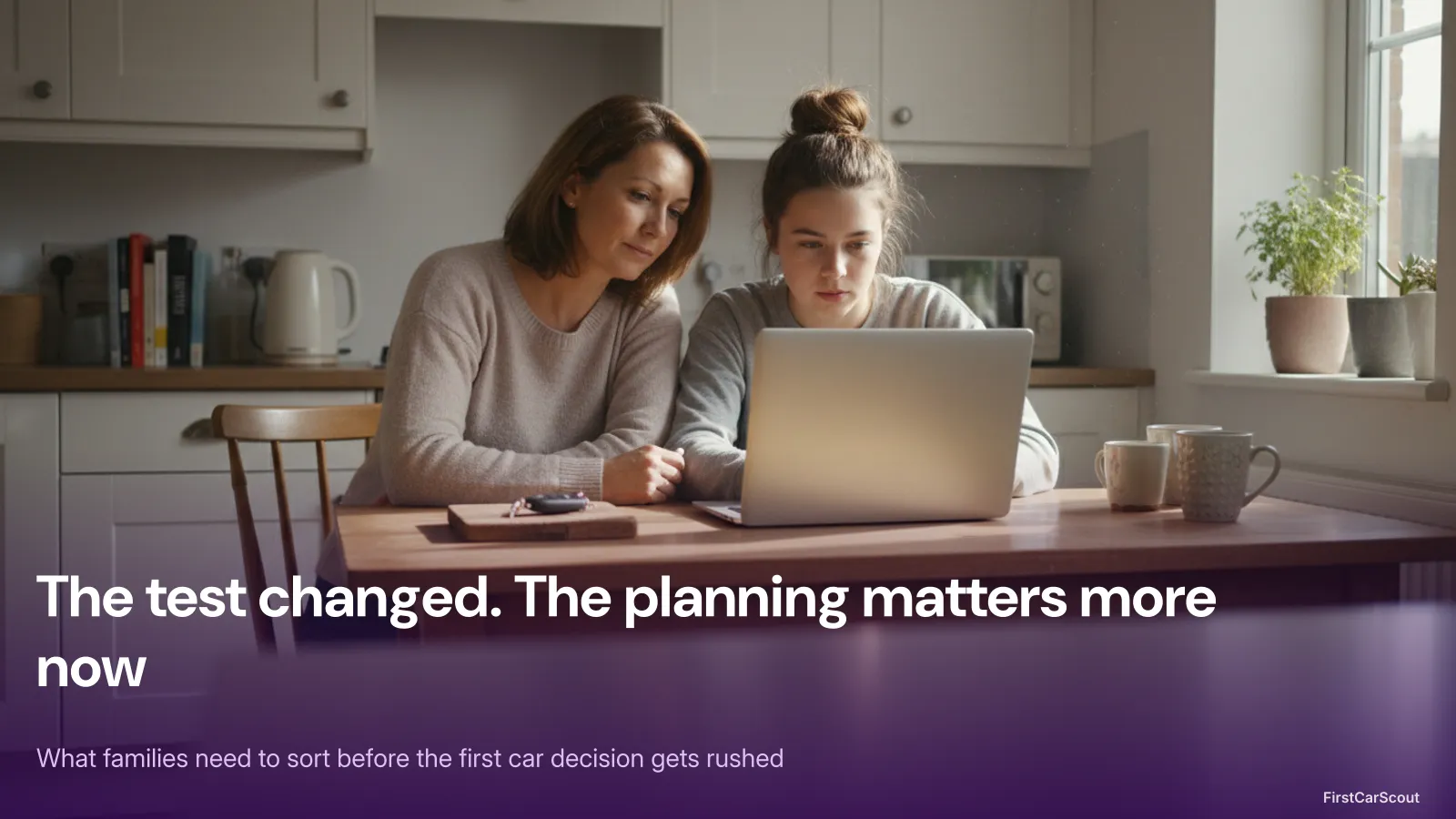
What parents cannot do under the new booking rules is manage the test appointment for the learner. The learner must have their own DVSA account and handle the booking themselves. Families can absolutely help a learner understand the system, check for available slots together, and plan around the likely wait. The learner just has to be the one who clicks confirm.
What to sort before the test
The period between starting lessons and sitting the test is the right time to make several decisions that most families leave until after passing.
Gearbox choice: If a learner passes in an automatic, their licence is restricted to automatic vehicles only. That shapes the first car search significantly. Automatic-only licences make practical sense for many new drivers, but it is worth understanding the restriction before the test rather than after.
Car choice: The cars that are genuinely affordable to run as a first vehicle tend to sit in low insurance groups, have small petrol or hybrid engines, and are common enough on UK roads that parts and servicing are cheap. Based on what new drivers in the UK regularly encounter, cars like the Toyota Yaris, Hyundai i10, Kia Picanto, and Skoda Fabia consistently come up as sensible starting points. The right answer depends on budget, gearbox preference, and how many miles the driver expects to cover.
Running costs, not just purchase price: The purchase price is only part of what a first car costs. Fuel, servicing, tax, and annual premiums are ongoing. New drivers under 25 typically see first-year premiums that are significantly higher than what experienced drivers pay for the same car, though black box policies can bring that number down meaningfully for drivers who build a clean record. A car that looks affordable at £3,000 on a forecourt can cost considerably more per year once everything is included.
L plates and practice cover: For private practice before the test, the learner needs L plates on the car and their own insurance in place. Some comparison sites offer short-term learner policies by the hour or day, which works well if practice sessions are infrequent. If practice is regular, a named-driver add-on or standalone annual learner policy tends to be better value.
What good planning looks like
A simple checklist for families working through this together:
- Learner sets up their own DVSA account early and checks local centre availability before assuming test timing
- Gearbox choice is settled before lessons are too far along, because switching late adds cost
- Car shortlist is built during the learning period, not the week after passing
- Running costs, including annual premiums for the specific car, are estimated before any purchase decision, not after
- Practice cover is in place before any private sessions happen, even on a quiet road
- If the test wait looks long, use the time to save more or narrow the car shortlist further
The test is a single day. The car is something a new driver lives with for years. The families who treat both as part of the same planning process tend to arrive at better outcomes on both.