Can Parents Teach a Learner Driver in the UK? The Real Rules
Parents can legally supervise a learner driver in the UK, but there are strict rules on age, licence, the car and insurance. Here is what actually needs to be true before your first practice run.
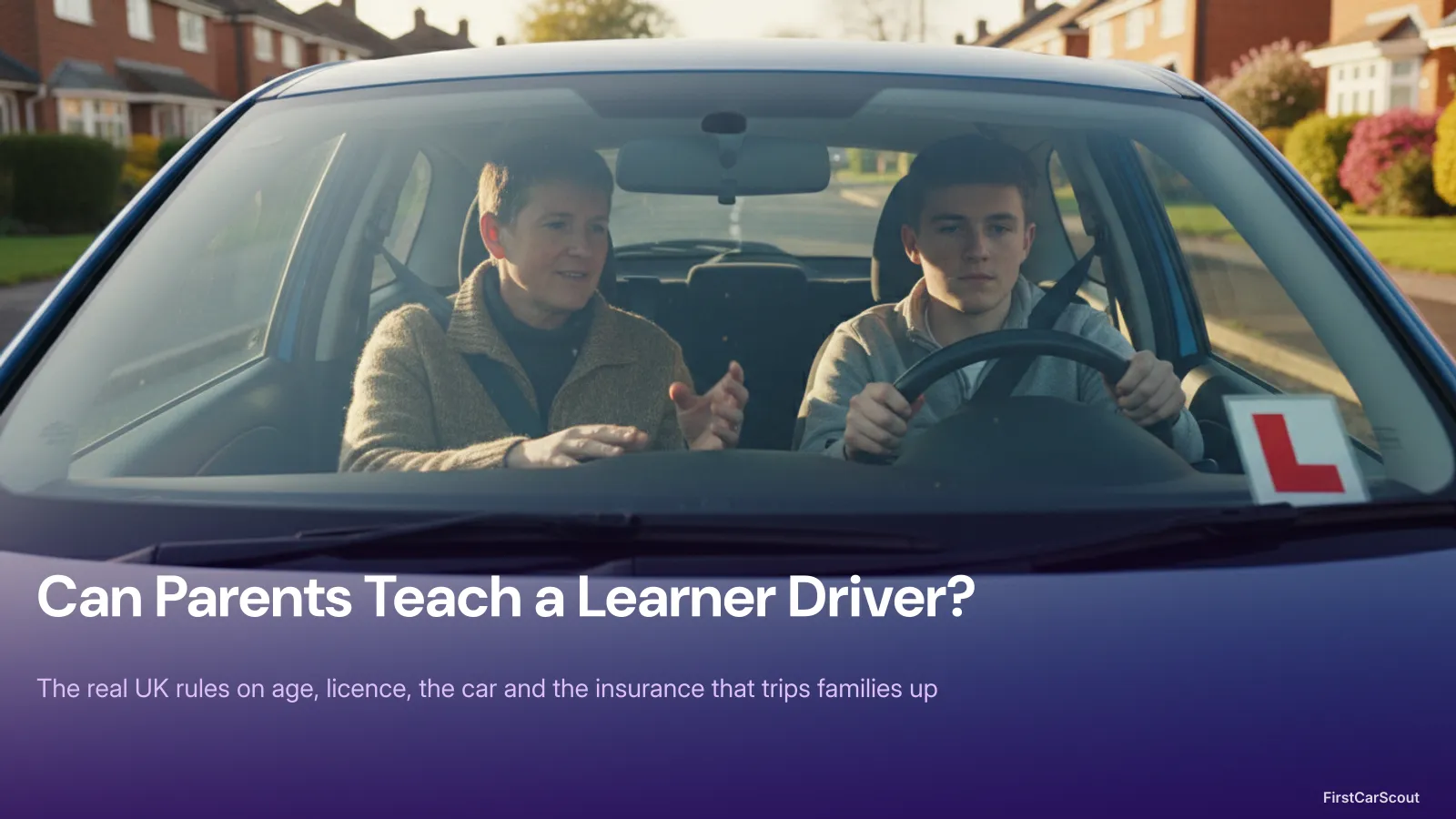
Yes, parents can teach a learner to drive in the UK. You do not have to be a qualified instructor to supervise private practice, which is why the vast majority of learners get extra hours from a parent, older sibling or family friend alongside their professional lessons. But the rules are specific, and getting one of them wrong (usually the insurance) is where people come unstuck.
This guide covers exactly what has to be true before you take a learner out, and the running-cost side that nobody warns you about.
Who is legally allowed to supervise
The supervising driver does not need to be a professional. A parent is fine. But they must meet all of these conditions at the same time:
- Be at least 21 years old.
- Hold a full driving licence for the type of car being driven (so a full manual licence to supervise in a manual, or at least a full automatic licence to supervise in an automatic).
- Have held that full licence for at least three years.
The three-year clock runs from when they passed their test, not from the date printed on the plastic card. Licences from the EU, Switzerland, Norway, Iceland and Liechtenstein count towards this too, as long as they are valid to drive in Great Britain.
One easy trap: if your parent only holds an automatic licence, they cannot supervise you in a manual. That matters more than people think, because a huge share of first cars and learner cars are manual.
What the learner needs
Before any private practice starts, the learner must:
- Hold a valid provisional driving licence.
- Display L plates (or D plates in Wales) on the front and back of the car, clearly visible.
- Be covered by insurance that specifically allows learner driving.
That last point is the one that catches families out, so it gets its own section.
The insurance rules parents miss
A learner must be insured to drive the specific car they are practising in, and the policy has to cover learner driving. Being a named driver on a parent’s normal policy is not automatically enough, because most standard policies do not extend to someone driving on a provisional licence.
There are two sensible routes:
- Short-term learner cover on the parent’s car. Providers like Collingwood, Marmalade, Veygo and Tempcover offer policies from a day up to a few months. The big advantage is that it protects the parent’s own no claims discount if the learner has a knock, because the learner’s incident sits on the temporary policy, not the parent’s main one.
- A learner policy on the learner’s own car, if they have already bought one before passing. This can then convert to a full policy once they pass.
Do not just assume you are covered. Call the insurer and confirm in plain terms that the learner is allowed to drive on a provisional licence. If they are not, and there is an incident, the policy can be treated as if it was never valid.
Where and when you can practise
Learners can drive on almost any road once they hold a provisional licence and are properly supervised and insured, including dual carriageways. The one exception used to be motorways, but that changed in 2018: learners can now practise on motorways in England, Scotland and Wales, provided they are with an approved driving instructor and in a car fitted with dual controls. A parent cannot supervise motorway practice.
Everything else, town driving, roundabouts, night driving, country lanes, is fair game for parent-supervised practice, and it is genuinely valuable. The DVSA’s own guidance encourages plenty of private practice alongside professional lessons, because more varied hours behind the wheel tends to mean a better first-time pass rate.
Practical rules for the drive itself
A few things that are easy to forget:
- The supervising parent counts as being in charge of the vehicle. That means the same alcohol and phone rules apply to them, and they can be penalised if things go wrong.
- The learner cannot carry passengers in a way that stops the supervisor doing their job.
- Keep the L plates on. Driving without them while learning is an offence.
A smart thing to line up early
If your teen is close to their test, this is the moment to start thinking about the car and its running costs together, not separately. As one parent asked us, the same car and driver can vary by hundreds of pounds a year depending on the insurer and whether it is a black box policy, so it pays to check premiums on a couple of low-group superminis before anyone falls in love with a specific car.
Start the practice properly insured, keep the L plates on, and make sure your licence actually matches the gearbox. Get those three right and there is nothing stopping a parent being the best (and most patient) instructor a learner has.