Why Buying Your First Car Is More Complicated Than It Looks
Choosing a first car looks simple. Then the variables collide: price, insurance group, engine size, safety, reliability. Here's why it's really a 100,000-variable problem, and how to cut through it.

Nobody tells you how many decisions are actually inside the decision to buy a first car.
It starts simply enough. You have a budget. You want something reliable. You go online. Within ten minutes, you are juggling price, mileage, age, engine size, insurance group, fuel type, safety ratings, service history, and whether the seller is two miles away or two counties away. Each variable connects to every other one. Change the budget and the insurance options shift. Change the engine size and the running costs move. Change the fuel type and the MOT history matters differently. Change the location radius and a whole new set of cars appears, each with its own combination of all the above.
It is not thirty decisions presented as one. Once you account for every combination of make, model, age, mileage band, engine variant, fuel type, insurance group, seller location, and how each of those interacts with the specific circumstances of the driver, you are looking at well over 100,000 interconnected decision variables. Most people have no idea.
They think they are choosing a car. They are actually trying to solve a combinatorial problem with no calculator and no instruction manual.
The scale of the market makes it worse, not better
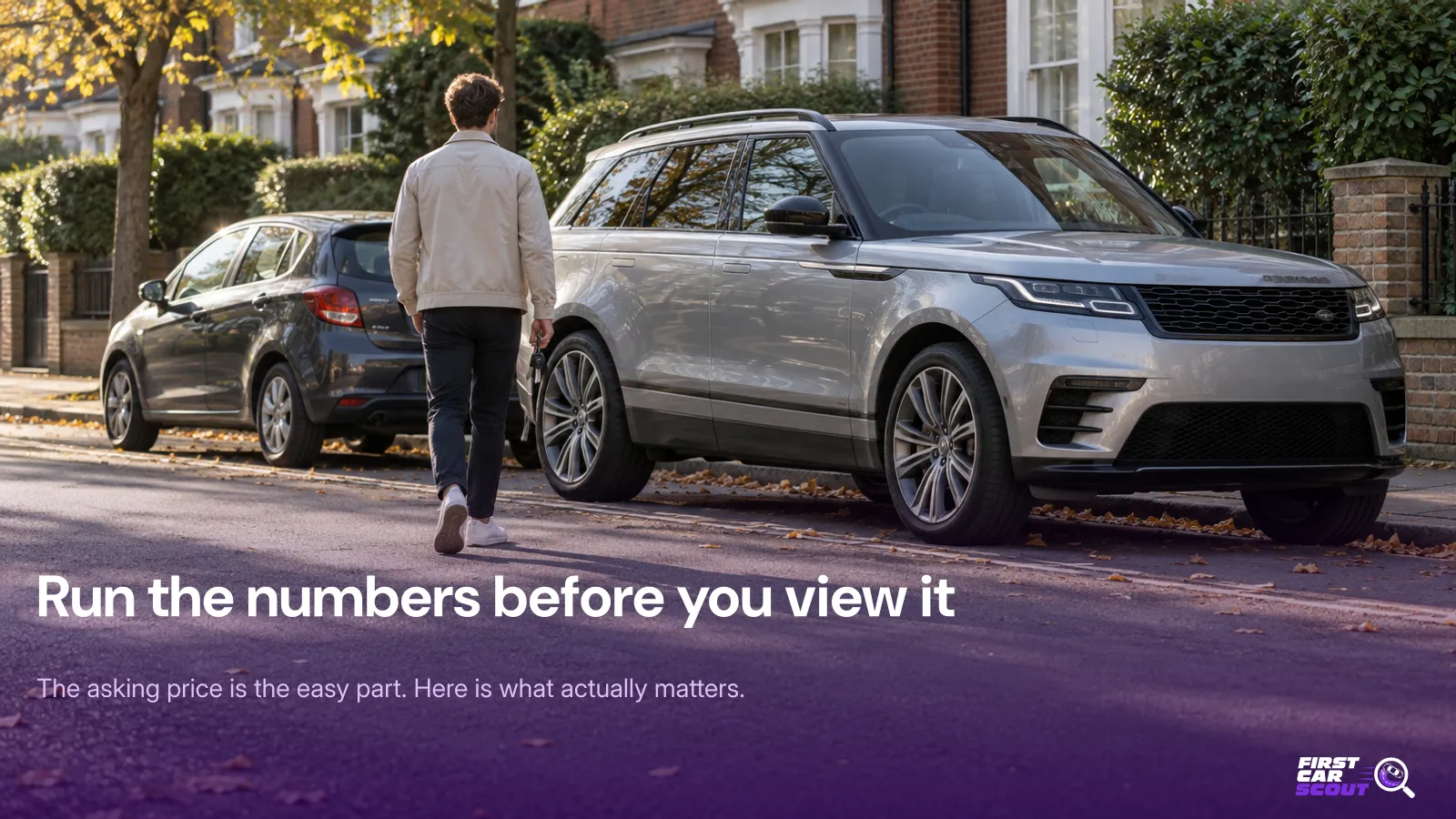
There is no shortage of first cars for sale. At any given time, there are thousands of used cars on the market under £6,000 that might, at a glance, appear suitable for a new driver. Run a basic search and you will get 800 results before breakfast. Each of those results carries its own bundle of variables. Multiply them out and the numbers become genuinely unmanageable.
The problem is that most of them are not suitable, once you apply the filters that actually matter.
A 1.6-litre hatchback at £4,800 might look ideal on a listing. For a 17-year-old with no no-claims bonus, the annual premium could be north of £3,500. The car is not affordable. It never was. But nothing in the listing told you that until you got a quote.
Multiply this across hundreds of listings, each with its own insurance group, engine variant, fuel type, and reliability history, and the 100,000-variable problem becomes visible. The search stops feeling productive. It starts to feel like a process designed to frustrate you.
The variables that matter most are the hardest to find
The factors that decide whether a first car is genuinely the right choice are rarely the ones shown prominently on listings sites.
Insurance group
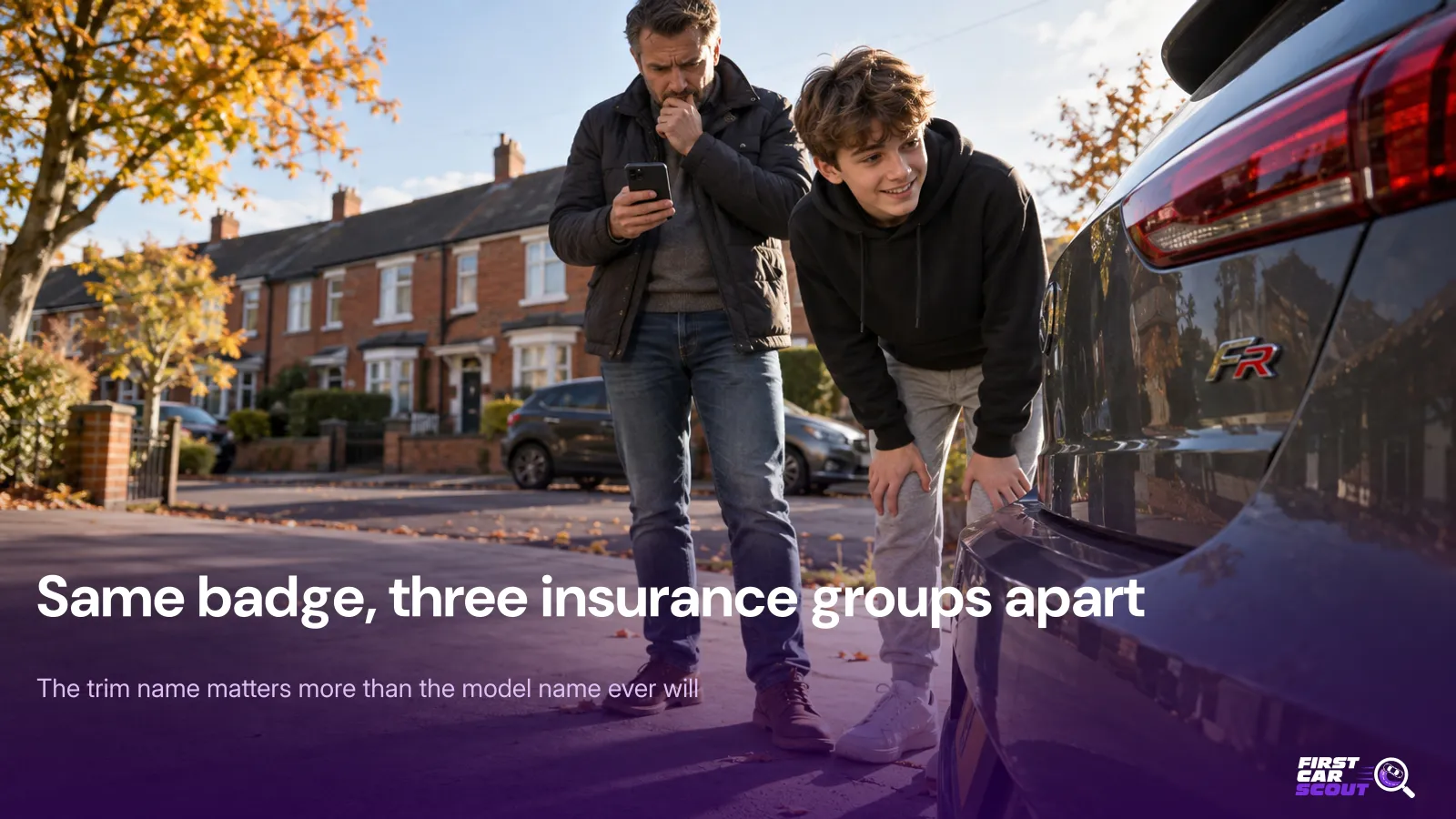
The factor most likely to make or break the decision for a young driver. Two cars can carry identical price tags and look identical on a results page, yet sit in group 4 and group 22. Their real cost of ownership is nowhere near the same.
Engine size
It feeds premiums directly. A 1.0-litre turbo can out-perform an older 1.4-litre and still cost far less to run. That is not obvious until someone shows you.
Fuel type
Diesel suits long motorway miles. For a young driver doing school, work and town runs, a petrol or small hybrid is usually the better, lower-cost fit.
Safety rating
It matters more for new drivers than for anyone. Euro NCAP scores vary widely inside a single price band. A five-star car and a three-star car can cost exactly the same.
Reliability
Invisible from a listing. Some models are well-documented, low-cost runners with cheap parts. Others come with forum threads full of warnings. You need to know which is which before you buy.
Parents and teenagers are not always searching for the same car
Part of what makes first-car buying genuinely hard is that it usually involves more than one person, and those people rarely want exactly the same thing.
A teenager buying their first car wants freedom, and something that does not make them feel like they are driving a punchline. A parent funding or co-funding the decision wants safety data, mechanical simplicity, and a car that will not need a recovery truck at 10pm on a Friday.
Both perspectives are legitimate. Neither is served well by mainstream listing sites, which are built for buyers who already know what they want, not for families trying to find common ground between practicality and what will actually get driven.
Most people find out the expensive way
The standard approach to first-car buying tends to run like this.
- 1 Find cars that look promising.
- 2 Get attached to one or two.
- 3 Get insurance estimates.
- 4 Discover the premiums do not work.
- 5 Go back to the start.
And round again. A slow, demoralising loop.
The more logical sequence is the other way round: work out which insurance groups are affordable first, then filter the listings to match. That just needs data and tools most buyers do not have to hand, so the inefficient process becomes the default.
The confusion is not a personal failing. The process is just broken
Every family going through first-car buying for the first time hits this wall. It is not because they are doing it wrong. It is because the tools available (search sites, comparison tools, reliability databases) are separate, each built for a different purpose, and none of them talk to each other in a way that helps a new driver make a confident decision.
First Car Scout was built for exactly this
First Car Scout connects the variables. Cost, engine size, fuel type, safety rating, reliability record, insurance group and location, all applied to a live market of available cars and filtered to match your situation.
The result is not 847 listings. It is a shortlist of cars that are genuinely worth your time.
The first-car decision is complicated. It does not have to stay that way.