Cheapest Cars to Insure for New Drivers in the UK, 2026
The car you pick does more to your premium than any deal you find. A ranked guide to the lowest-insurance-group first cars in the UK, with real group numbers and monthly running cost data.
The single biggest lever on a new driver’s car insurance is the car itself. Insurance groups run from 1 to 50, and the same driver, same address, same telematics box will pay noticeably less in a group 1 car than in a group 20 car. Picking the right car before you shop for cover is where most new drivers leave the most money on the table.
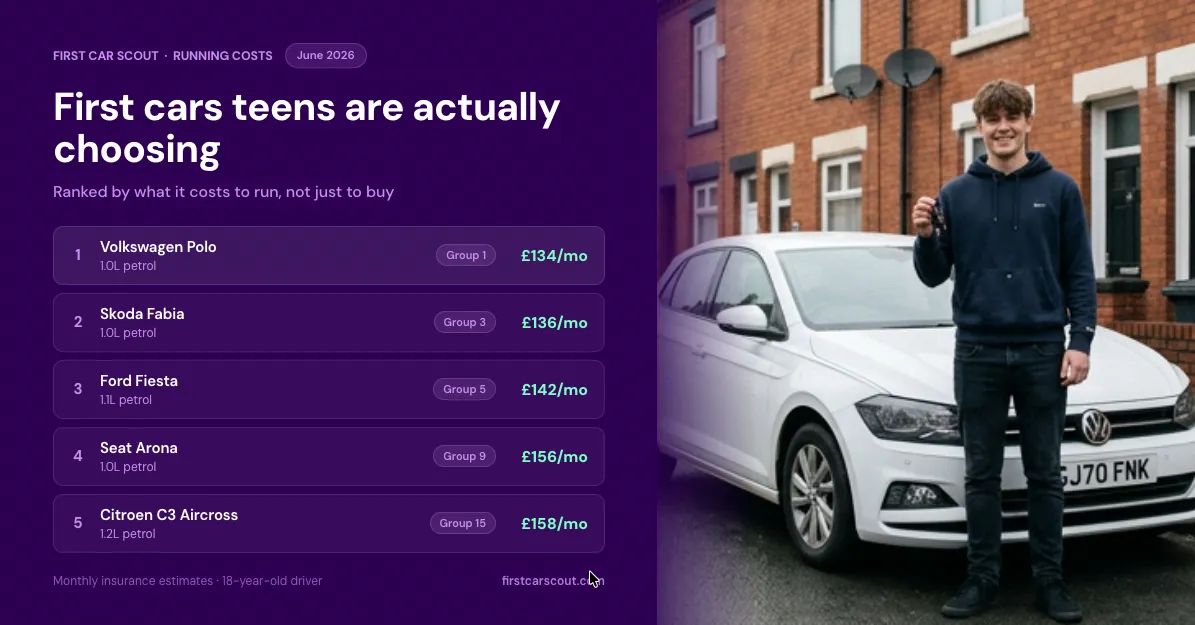
Here are the cheapest cars to insure for new drivers in the UK right now, ranked by insurance group, with our data on what each one costs to run per month all in.
The ranked list
| Car | Engine | Insurance group | Est. monthly insurance | Est. monthly running cost |
|---|---|---|---|---|
| Volkswagen Polo | 1.0L petrol | 1 | £134 | £250 |
| Skoda Fabia | 1.0L petrol | 3 | £136 | £254 |
| Ford Fiesta | 1.1L petrol | 5 | £142 | £262 |
| Seat Arona | 1.0L petrol | 9 | £156 | £275 |
| Citroen C3 Aircross | 1.2L petrol | 15 | £158 | £287 |
Running cost figures are for an 18-year-old driver and cover insurance, fuel, road tax and servicing combined. Insurance figures are monthly estimates from our own data. Your actual premium will vary with your address, how you use the car and which policy you choose.
The engine version trap
The Volkswagen Polo 1.0L petrol is insurance group 1. The Volkswagen Polo 1.5L petrol is group 21. The badge on the boot does not tell you which group you are looking at, and most listings lead with the model name, not the engine code.
This is the catch that trips up most “cheapest cars to insure” searches: buyers find the right model but go home with the wrong version. Before you commit to any car, confirm the exact engine size, then check its current group. The ABI publishes the official list and every insurer uses it.
The same rule applies to every model on this list. The Fiesta 1.1L sits in group 5; other Fiesta engines run up to group 16. Always check the specific registration you are buying, not just the name.
What insurance groups actually measure
Every car sold in the UK is assessed on:
- Repair cost: parts and labour after a typical low-speed bump
- New car price: more expensive to replace means a higher group
- Performance: a bigger engine raises both the repair cost and the statistical risk profile
- Security: factory alarms and immobilisers pull the group down
- Parts availability: rare or imported parts push it up
Groups 1 to 10 is where a new driver wants to be. Groups 1 to 5 are the sweet spot: cover that is genuinely affordable, on a car that is still worth driving day to day.
What else moves your premium
The car’s group sets the floor. A few other choices affect what you actually pay on top of it.
Telematics (black box). A policy that records your driving can reduce a new driver’s premium by several hundred pounds in the first year. The car’s group still matters with a telematics box: the discount lands on top of whatever the base rate is, so starting in a lower group multiplies the saving.
Named driver on a parent’s policy. Adding yourself to an experienced driver’s policy as a genuine secondary driver is often cheaper in the first year than a standalone policy. The gap closes as you build your own no-claims record.
Mileage and parking. Declaring a lower annual mileage and off-road overnight parking both reduce premiums. Commuting by car adds to it.
The full picture
Insurance is the biggest line on a new driver’s monthly running cost, but not the only one. Fuel, road tax and servicing combine with it to give you the real monthly number. Our best first cars in the UK guide ranks every car on the all-in monthly total rather than insurance alone, so you can see where each model lands when the full cost is added up.
Common questions
What is the cheapest car to insure for a new driver in the UK?
On our current data, the Volkswagen Polo 1.0L petrol sits in insurance group 1 with an estimated monthly running cost of £250 for an 18-year-old driver. The Skoda Fabia 1.0L (group 3) and Ford Fiesta 1.1L (group 5) are close behind. All three carry a 5-star Euro NCAP rating.
Is it always better to buy the lowest insurance group car?
Not always. A lower group usually means a lower premium, but the monthly total also includes fuel, tax and servicing. A car in a slightly higher group with better fuel economy can cost less per month overall. Always calculate the full monthly running cost before deciding.
Do telematics policies make insurance groups less important?
No. A telematics box reduces your premium relative to what it would be for that same car on a standard policy. If you start in a high group, the box saves you money compared to a non-telematics policy in that group, but you will still pay more than a driver in a low group with a box. The group is the baseline; telematics is a discount applied to it.
How often do insurance groups change?
The ABI updates groups when a model changes or new claims data comes in. A car registered three years ago may sit in a different group to the same model registered today. Always check the group for the specific year and engine you are buying, not just the nameplate.
Does the colour of a car affect insurance?
No. Colour has no effect on insurance group or on most policies. It is a persistent myth with no basis in how groups are calculated.
Should I check the insurance group before or after I find the car?
Before, if possible. Knowing which groups fit your budget lets you filter your search to models that work, rather than falling for a car and then discovering the group puts it out of reach.