The First-Car Trap: Cheap to Buy, Expensive to Run
A car that is cheap to buy can quietly cost more than its sticker price in the first year alone. Here is how two £4,500 cars end up £1,500 apart, and how to spot the trap before you commit.
You find a car for £4,500. It looks tidy, it drives well, the MOT has a few months left. Job done, right?
Not quite. The purchase price is the one cost you pay once. Everything else carries on, month after month, whether the car moves or not. And for first-time buyers, especially young drivers, those running costs can easily add up to more than the car itself in the first year alone.
This is one of the most common, and most painful, traps in the first-car market. Understanding it before you buy could save you thousands.
Why the sticker price is misleading
When most people search for a first car, they set a budget based on what they can afford to buy. They filter by price, find something in range, and assume the hard part is over.
But owning a car and buying a car are two completely different expenses. The purchase is a one-off. The running costs never stop. And for young drivers, those costs are far higher than most people expect.
The four big ones are:
- Insurance, often the biggest annual cost, especially for drivers under 25
- Fuel, which varies significantly depending on engine size and efficiency
- Road tax (VED), usually modest, but older higher-emission cars cost more
- Servicing and maintenance, where the real surprises tend to hide
Get the wrong car and all four can work against you at once.
A tale of two £4,500 cars
To show how big the difference can be, consider two cars at almost exactly the same purchase price.
Car A: VW Up 1.0 (2016). A small, sensible hatchback with a 1.0-litre engine, sitting in insurance group 2. Easy to run, reliable, cheap to service.
Car B: BMW 1 Series 116i (2012). A used premium hatchback that has dropped in value. Good badge, decent drive, and available for the same money as the VW Up. Sounds tempting.
Here is what the numbers look like over a year, for a typical 18-year-old driver covering around 7,000 miles.
| Cost | VW Up 1.0 (2016) | BMW 1 Series 116i (2012) |
|---|---|---|
| Purchase price | £4,500 | £4,500 |
| Insurance (est.) | £1,350 | £2,200+ |
| Fuel (annual) | £680 | £950+ |
| Road tax | £20 | £180 |
| Servicing & MOT | £280 | £500+ |
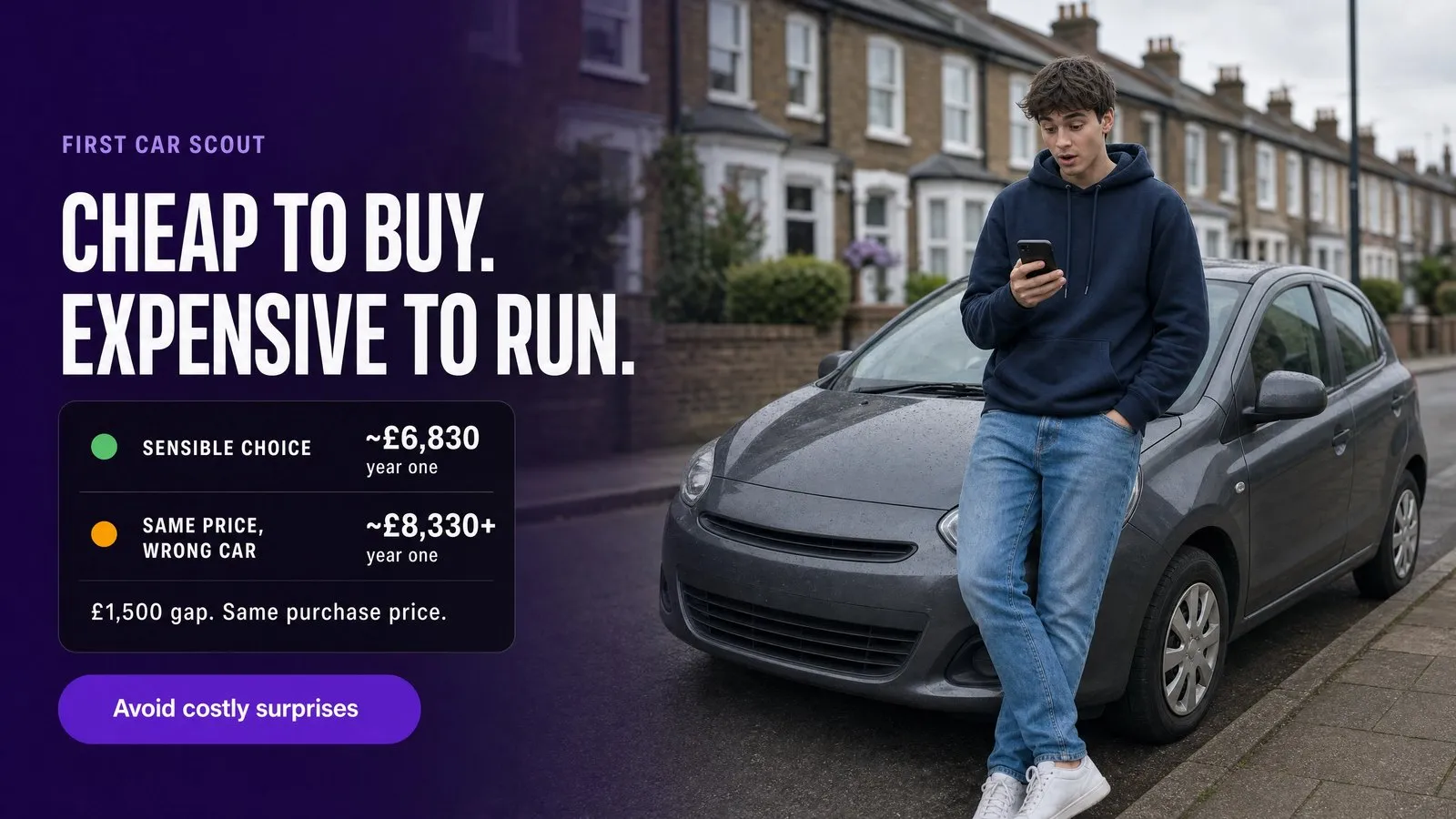
| Total year one | ~£6,830 | ~£8,330+ |
That is a gap of around £1,500 in the first year alone, on two cars that cost exactly the same to buy.
The BMW’s insurance group is around 20, compared to the VW Up’s group 2, so premiums are dramatically higher for a young driver. Fuel economy is lower. Parts and servicing for a prestige brand are more expensive. And older BMWs from this era have a known history of timing chain issues, which can turn a routine service into a four-figure repair bill.
None of that shows up in the listing price.
Premiums: the cost that surprises almost everyone
For young drivers, insurance is not just a line on a spreadsheet, it can be the single biggest annual expense they face.
The average premium for a driver aged 17-24 is now around £1,121 per year, according to Quotezone’s Q1 2026 data. But that is an average across all cars, and not the first year of driving alone, which is usually a lot higher. Choose a car in a high insurance group and that figure climbs fast.
Insurance groups run from 1 to 50. Cars in the lowest groups, typically small, low-powered models with widely available parts, are the cheapest to cover. The difference between group 2 and group 20 can be hundreds of pounds a year. For a first-time buyer already paying a premium just for being young, that difference matters enormously.
Fuel: the quiet drain
A car that does 30 miles per gallon costs significantly more to run than one doing 45 mpg, and over 7,000 miles a year that gap is real money.
At current UK petrol prices (around £1.42 per litre as of early 2026), a 1.0-litre car averaging 42 mpg costs roughly £680 a year in fuel. A larger or older engine averaging 30 mpg on similar mileage adds another £270 a year, or £1,350 over five years, quietly left at the pump.
Small engines are not just cheaper to insure. They are cheaper to run every single day.
Maintenance: where cheap cars become expensive ones
An older car with a low purchase price can seem like excellent value, until it needs work.
Some models have known reliability issues. Others have expensive parts, or need specialist servicing that independent garages struggle with. Tyres vary too: a car with wider, lower-profile tyres costs more to replace than one running standard sizes.
Then there is what happens when things go wrong. An older car without a service history, or one with a known weak point the seller did not mention, can produce unexpected bills that dwarf the running costs of a more sensible choice.
This is where a proper history check and a realistic look at likely maintenance costs pay for themselves. Cheap to buy is not the same as cheap to own.
The number that actually matters: total cost of ownership
Rather than asking “what can I afford to buy?”, the better question is “what can I afford to run?”.
When you add up insurance, fuel, tax and maintenance over 12 months, the picture often looks very different from the purchase price alone. A car that costs £5,000 to buy but £2,300 a year to run is much better value than a £4,000 car that costs £3,800 a year, even though the second one looks cheaper on paper.
The goal is to find the car with the lowest total cost of ownership in year one, not just the lowest price on the forecourt.
How First Car Scout helps
This is exactly the kind of calculation that is hard to do quickly, and easy to get wrong.
First Car Scout is built to help first-time buyers and their families see the full picture before they commit. Not just the purchase price, but the real annual cost: insurance, fuel, tax and maintenance, estimated for your specific situation. That way you can compare cars properly, not just by what they cost to buy, but by what they will actually cost to own.
Because the cars that look like bargains are not always the ones that are.